
Key Takeaways
- Onboarding is where a won deal can quietly go cold.
- A good customer profile has seven parts, from legal identity to credit limit.
- GST, PAN, address and bank details should agree with each other before anything is saved.
- Credit profiling works best as one case with three reviews running at the same time.
- A customer is order-ready only when the ERP is ready, not when the CRM says "won".
Most sales automation conversations stop at the “won” stage. But for B2B companies that sell on credit, the real finish line is the first order. Between them sits onboarding: documents, verification, credit and ERP setup.
This guide walks through that stage step by step. It covers what a complete customer profile looks like, which documents to collect, how to check GST and PAN details, how credit profiling works and where automation makes the biggest difference.
What Is B2B Customer Onboarding?
B2B customer onboarding is the process of turning a prospect who has agreed to buy into a customer who can place orders. It includes collecting KYC documents, verifying tax, address and bank details, building the customer profile, assessing credit risk, agreeing payment terms and creating the customer in the ERP.
In sales terms, it is the bridge between “prospect” and “customer”. It usually involves at least three teams.
Sales
Owns the relationship.
Finance Or Credit
Owns the risk.
Operations
Owns the master data in the ERP.
Why Customer Onboarding Is Where Good Deals Stall
Customer onboarding stalls because documents arrive in pieces, checks happen one after another instead of together, several teams wait on each other and nobody owns the whole process. The buyer, who already said yes, waits without knowing why.
Documents arrive in pieces
What Happens: One on WhatsApp, one by email, one as a blurry photo. Someone has to collect and chase them.
Details don’t match
What Happens: The legal name on the GST certificate differs from the bank letter. Nobody spots it until later.
Reviews run one by one
What Happens: Compliance, then market research, then credit. Each waits for the last.
None of these steps is optional. The problem is the order they happen in and how much of the chasing depends on people remembering.
What Goes Into A Complete B2B Customer Profile?
A complete B2B customer profile has seven parts: legal identity, tax registration, addresses, bank details, key contacts, commercial terms and risk assessment. Each part should come from a verified source, and the details should agree with each other across documents.
Legal identity
What It Includes: Legal name, trade name, type of entity
Usual Source: GST certificate, incorporation or partnership documents
Who Confirms It: Sales operations
Tax registration
What It Includes: GSTIN, PAN, GST status
Usual Source: GST certificate, PAN card
Who Confirms It: Finance
Addresses
What It Includes: Registered, billing and delivery addresses
Usual Source: GST certificate, address proof
Who Confirms It: Sales operations
Bank details
What It Includes: Account name, number, IFSC
Usual Source: Cancelled cheque or bank letter
Who Confirms It: Finance
Key contacts
What It Includes: Decision maker, purchase contact, accounts contact
Usual Source: Conversation with the customer
Who Confirms It: Salesperson
Commercial terms
What It Includes: Products, expected volumes, requested payment terms
Usual Source: The sales conversation
Who Confirms It: Salesperson and sales head
Risk assessment
What It Includes: Compliance status, market feedback, credit limit
Usual Source: Credit profiling
Who Confirms It: Credit approver
Which KYC Documents Do You Need From A Business Customer?
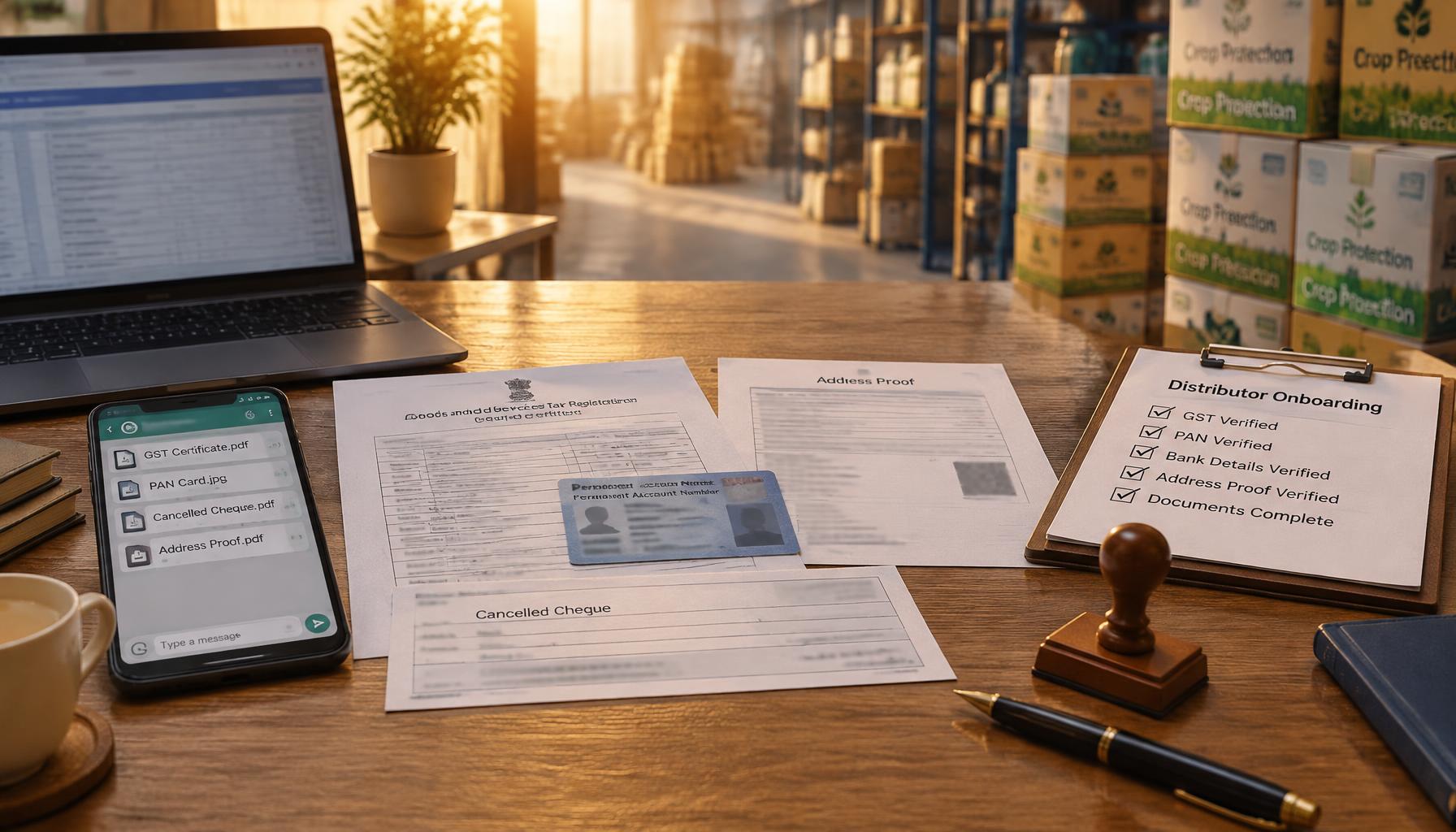
Most B2B sellers in India ask for a GST registration certificate, the business PAN, an address proof, a cancelled cheque or bank letter, and identity proof of the authorised signatory. Companies and partnerships may also need incorporation or partnership documents. The exact list depends on your credit policy and the customer’s business type.
GST Registration Certificate
For the legal name, GSTIN, registered address and type of business.
PAN Of The Business
For tax identity.
Address Proof
Where the delivery or billing address differs from the GST address.
Cancelled Cheque Or Bank Letter
For payment and refund details.
Authorised Signatory ID
For the person who signs on behalf of the business.
Entity Documents
Such as a certificate of incorporation or partnership deed, where your policy requires them.
A simple habit saves days: send the customer the full list in one message, and say what each document is for.
How To Verify GST And PAN Details During Onboarding
Check that the PAN inside the GSTIN matches the business PAN, that the legal name is the same on the GST certificate, PAN and bank documents, that the addresses agree, and that the GST registration is active. Mismatches are the most common reason onboarding gets delayed later.
A GSTIN has a structure you can check at a glance.
Example GSTIN · 15 Characters
27
State Code
27 = Maharashtra
ABCDE1234F
PAN Of The Business
Must match the PAN card
1
Entity Number
Registrations under one PAN
Z
Default Letter
Usually Z
5
Check Character
Validates the number
Quick Test: Characters 3 To 12 Should Equal The Business PAN.
Four checks catch most problems:
- 1
PAN Inside The GSTIN
Characters 3 to 12 of the GSTIN should equal the business PAN.
- 2
One Legal Name Everywhere
The name should be the same on the GST certificate, PAN and bank documents. Small differences cause big delays later.
- 3
Addresses Agree
The billing address should match the GST registration, or be backed by a separate address proof.
- 4
Registration Is Active
Check the GST status and, if your policy requires it, how regularly returns are filed.
What Is Customer Credit Profiling, And How Does It Work?
Customer credit profiling is the assessment that decides whether to sell to a customer on credit, and on what terms. It usually combines three views: compliance, to confirm the business is legitimate; market research, to understand its reputation; and credit monitoring, to judge payment behaviour and a safe credit limit.
One Credit Case
Opened for the new customer
Compliance
Is the business legitimate? Any red flags?
Market Research
Reputation, size, trade references.
Credit Monitoring
Payment behaviour, safe credit limit.
One Page, All Reviews
The approver decides
Approve with a credit limit
Approve with advance payment
Decline or ask for more
Illustrative. Outcomes follow your own credit policy.
The biggest gain comes from one change: running the three reviews in parallel, not in a queue. Each team still does its own work. The case simply stops waiting for one team to finish before the next one starts.
The outcome is not always yes or no. Many B2B sellers approve a new customer on advance payment for the first few orders, then review the credit limit once there is a payment history.
How Market Research Fits Into Customer Onboarding
Market research adds what documents can’t show: how the customer is seen in the market, how they pay other suppliers, how big their business really is and whether their stated volumes are realistic. It usually comes from trade references, field visits, the sales team’s knowledge and public information.
Useful Questions For A Distributor
- Which other brands do they carry?
- How long have they been in business?
- What do other suppliers say about their payments?
- Do their warehouse and reach match the volumes they promised?
This review is the easiest to forget, because it has no form to fill. Making it a fixed part of the credit case means it is never skipped.
How Automation Speeds Up B2B Customer Onboarding
Automation speeds up customer onboarding by reading documents as they arrive, flagging mismatches early, opening the credit case automatically, sending all review requests at once, chasing late reviewers and creating the approved customer in the CRM and ERP. People still verify details and make the credit decision.
- 1
Documents Arrive
On WhatsApp or email.
- 2
Read And Summarised
Beside each original. Blurry or missing copies are flagged.
- 3
A Person Verifies
Only verified details are saved.
- 4
Credit Case Opens
Three reviews requested at once. Late reviewers are reminded.
- 5
Approver Decides
All reviews on one page.
- 6
Customer In CRM
Only approved terms.
- 7
ERP Code Ready?
If not, the code is requested and the customer is not order-ready yet.
- 8
Order-Ready
The first order can be placed and invoiced.
Collecting documents from chat and email
People Decide: Which document details are valid
Reading and summarising each one
People Decide: Compliance and market findings
Spotting blurry, missing or mismatched details
People Decide: The credit limit and payment terms
Opening the credit case and requesting reviews
People Decide: Whether to approve the customer
Reminding late reviewers
People Decide: How to handle exceptions
Checking for and requesting the ERP code
People Decide: When the relationship is ready to grow
How Mimasa Automates Customer Onboarding
Mimasa automates B2B customer onboarding from the first document to an order-ready customer. It reads KYC documents from WhatsApp and email, shows each summary beside the original, runs credit profiling as one case with parallel reviews, gives the approver one page to decide, and creates the customer in the CRM and ERP with approved terms only.
- Documents Read On Arrival
- GST certificates, PAN, bank proofs and address proofs are read as they arrive on WhatsApp or email, with a summary shown beside each original.
- Problems Caught Early
- Blurry scans and missing documents are flagged straight away, and the customer is asked for a clearer copy.
- Verified Data Only
- A person confirms the details, and only verified information reaches the customer record.
- One Credit Case
- Compliance, market research and credit monitoring receive their requests together. Mimasa tracks who has replied, sends reminders and matches every report to the right case.
- One Page To Decide
- When every review is in, the approver sees them side by side and makes the call.
- Approved Terms Only
- The prospect becomes a customer in the CRM with exactly the terms the departments approved.
- ERP-Ready, Not Just CRM-Ready
- Mimasa checks for the ERP customer code and requests it if it’s missing. Until it exists, the customer isn’t marked ready for orders.
Onboarding is one part of Mimasa’s end-to-end sales flow, between the first conversation and the first order. See Sales Automation for the full journey.
Bring Your Onboarding Checklist
We’ll map your documents, reviewers and approval rules, and show how Mimasa runs them as one case.
B2B Customer Onboarding Checklist
A practical B2B onboarding checklist covers four stages: documents collected, details verified, credit approved and ERP setup complete. A customer should move to order-ready only when every item is ticked.
Stage 1
Documents Collected
GST certificate, business PAN, address proof, cancelled cheque or bank letter, signatory ID and any entity documents your policy needs.
Stage 2
Details Verified
PAN inside the GSTIN matches, one legal name across documents, addresses agree and GST registration is active.
Stage 3
Credit Approved
Compliance, market research and credit monitoring reviewed, and a limit or advance-payment terms approved.
Stage 4
ERP Setup Complete
Customer created with approved terms and an ERP customer code in place. Only now is the customer order-ready.