
Contracts and Amendments
Read agreements, schedules, amendments, and side letters. Compare their terms. Flag missing fields, conflicting values, and clauses that need review.
Data ExtractionConnect media contracts, rights records, royalty statements, usage reports, revenue data, and spreadsheets. Mimasa AI pulls out the key terms and applies your approved rules. It then reconciles the evidence and flags possible exceptions for human review.
Add AI contract analysis and agentic workflows to the systems you already use. Agents check incoming data, prepare calculations, and watch rights conditions. They route discrepancies, build reports, and act only when approved.
For broadcasters, OTT platforms, studios, production houses, music and audio businesses, publishers, distributors, and enterprise content owners.
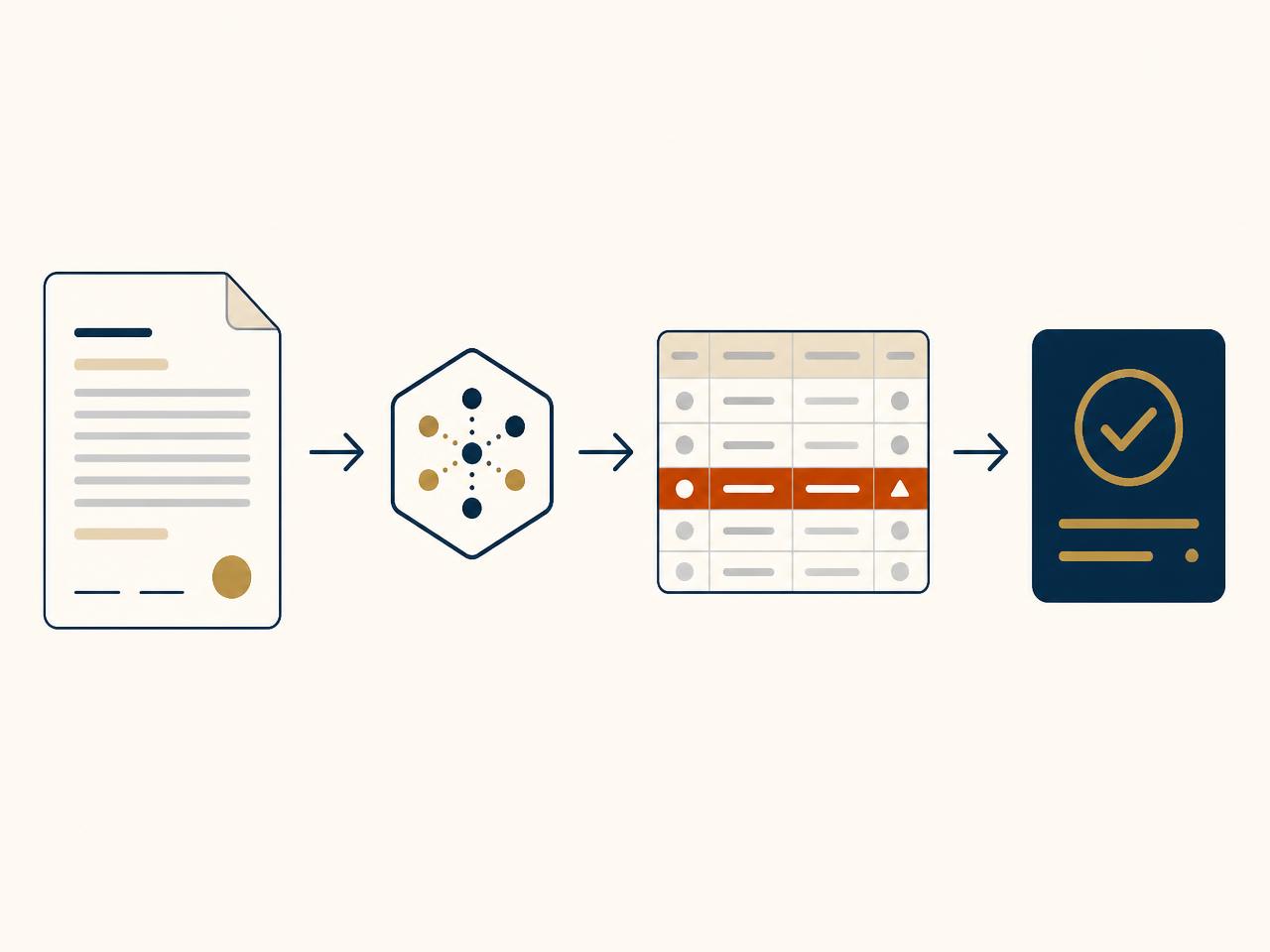
Rights and royalty work depends on scattered information. It sits in contracts, amendments, schedules, usage reports, partner statements, spreadsheets, emails, finance systems, and rights platforms. Each party may use different title IDs, currencies, territories, revenue categories, and reporting periods.
Traditional royalty management software holds the records and the calculations. Teams still do the manual work around it. They pull terms out of contracts, clean files, match records, chase missing data, and build the evidence pack for approval.
Mimasa adds an AI analysis and automation layer around that work. It runs AI contract data extraction through Data Extraction and structures the obligations it finds. It then standardizes usage and revenue data, applies your approved rules, and flags possible discrepancies. Governed agents coordinate the next step.
AI contract analysis reads an agreement and organizes what it finds. Teams can then review obligations without reading and retyping every page. In rights and royalty work the useful fields are familiar ones.
Mimasa pairs AI contract intelligence with workflow controls. Each extracted field can link back to the source document, clause, page, or section. Required values and conflicts are checked. Anything unclear or high-value goes to an authorized reviewer.
AI analysis does not replace legal reading. Contracts carry amendments, cross-references, undefined terms, and negotiated context. Mimasa prepares the evidence and the review task. Qualified people approve the meaning used by later calculations and actions.
Rights and royalties management improves when contracts, records, usage, revenue, and statements are analyzed together rather than reviewed file by file.
Read agreements, schedules, amendments, and side letters. Compare their terms. Flag missing fields, conflicting values, and clauses that need review.
Data ExtractionConnect approved records for titles, assets, territories, platforms, languages, windows, and parties. Mimasa works alongside media rights management software and content rights management systems. It does not replace them.
Process streams, views, broadcasts, downloads, performances, sales, and deliveries. Any usage measure named in the contract can be used.
Connect approved revenue, deductions, advances, minimum guarantees, and recoupment balances. Costs and payment data can be added where the calculation needs them.
Read statement lines and map each one to its contract, period, asset, party, territory, or revenue category. Missing or inconsistent fields are flagged.
Bring in CSV, XLSX, database, API, storage, document, finance, and rights-platform data. Access follows the integrations and permissions you allow.
Data TransformationEach step stays traceable to the approved contract interpretation, source data, rule, and reviewer decision.
Use AI contract analysis to propose structured rights, rates, splits, thresholds, windows, obligations, and reporting terms. Route uncertain fields for validation.
Map titles, asset IDs, party names, territories, currencies, periods, usage types, and revenue categories across files and systems.
Use customer-approved rules for rates, tiers, splits, minimums, deductions, recoupment, currency conversion, rounding, and other contractual conditions.
Compare the rights and royalty logic with available distribution, usage, revenue, calculation, statement, and payment data.
Flag missing records, unmatched assets, expired windows, out-of-scope territories, calculation variances, duplicate lines, unexpected deductions, or incomplete statements.
Create a case containing the source clause, affected records, calculation, variance, available evidence, owner, and permitted decisions.
Generate a report, request information, create a task, record a decision, prepare an adjustment, notify a stakeholder, or update an authorized connected system.
A detected variance is evidence for review. It does not prove underpayment, overpayment, breach, or unlicensed use.
Mimasa moves beyond document extraction and dashboards. Agents built in Agent Builder can coordinate recurring work across data, rules, people, and systems.
Monitor an approved source for new contracts or amendments, extract defined terms, validate required fields, and create a review task for unresolved items.
Track approved rights records for approaching expirations, reporting deadlines, missing deliverables, restricted territories, or platform conditions.
Collect the required contract, usage, revenue, and statement data, run approved checks, group exceptions, and prepare evidence for finance or rights review.
Identify absent statements, unmapped titles, incomplete fields, or unmatched partner records and create the appropriate request or task.
Prioritize potential discrepancies by value, deadline, partner, contract, reason, or confidence. Route each case to the authorized reviewer.
Generate periodic royalty, rights, exception, reconciliation, and management reports using approved information and formats.
Agent actions must follow roles, permissions, financial controls, and approval policies coordinated in Workflow Builder.
Buyers looking at royalty accounting software or royalty calculation software want repeatable formulas. They also need statement preparation, accruals, payment records, and financial controls.
Mimasa does not replace the general ledger, ERP, payment system, or your system of record. It works alongside them. It pulls the contract rules, prepares the calculations, reconciles several data sources, and documents exceptions. Approved results are sent on to the right downstream process.
Every material result stays traceable. You can trace it back to the approved reading of the contract, the source data, the rule used, and the reviewer who signed it off.
Royalty reporting is a repeating chore. You collect partner files, check fields, refresh calculations, explain variances, and build the statement or management pack. Mimasa automates that preparation layer.
This works with your royalty reporting software and finance process through Data Visualisation and Dashboards. It does not approve payments on its own. It does not issue legally binding statements. For content ROI and campaign revenue, see Media Content and Campaign Performance.
AI content licensing workflows capture the conditions attached to each asset. That covers territory, language, platform, format, audience, and exclusivity. It also covers start and end dates, holdbacks, sublicensing, promotion, and reporting duties. Agents then watch those conditions for you.
Mimasa adds rights analysis and workflow automation next to your content licensing software. It is not DRM software. It does not encrypt files, enforce playback licences, or stop copying. Specialist content-protection tools still do that job.
“Which contracts have royalty reports due this month?”
“Show usage records that could not be matched to an active right.”
“Which titles have rights expiring in the next 90 days?”
“Explain the largest statement variances for this reporting period.”
“Which deductions do not match the approved contract rules?”
“Show royalty calculations awaiting finance approval.”
“Prepare a reconciliation report with source clauses and evidence.”
“Create a review task for each high-value exception.”
The final examples show automated reporting and agentic workflow, not query alone.
Monitor licensed titles, territories, platforms, availability windows, usage, partner statements, revenue shares, and royalty obligations across approved sources.
Extract terms from distribution, talent, production, and licensing agreements. Match relevant usage and revenue data and route exceptions for legal, finance, or commercial review.
Process contracts, usage files, royalty statements, splits, rates, reporting periods, and partner data. Configure workflows around the organization's catalogue and agreements.
Analyze licensing agreements, content usage, territories, channels, revenue shares, and recurring reporting obligations.
Track approved rights across competitions, territories, platforms, languages, sublicensing conditions, distribution windows, usage reports, and commercial agreements.
Give each authorized function access to the evidence, exceptions, tasks, approvals, and reports relevant to its role.
Rights and royalty work touches sensitive material. That includes confidential contracts, personal information, commercial rates, revenue, payments, and legal duties. So every AI output stays controlled and open to review.
Specific accounting, tax, legal, regulatory, privacy, retention, residency, and security requirements must be evaluated during solution design. Read more about Data Governance.
Use AI to prepare structured terms, mappings, calculations, exceptions, and reports for human review.
Apply approved identifiers, formulas, thresholds, periods, currencies, and validation rules across recurring workflows.
Use agents to monitor deadlines, missing data, unmatched usage, rights conditions, and calculation variances.
Give reviewers access to relevant clauses, source data, calculations, explanations, and prior decisions.
Move from an exception to a task, information request, report, adjustment preparation, notification, or authorized system update.
Use access rules, separation of duties, human approvals, lineage, and audit trails for consequential actions.
Connect extracted contract terms with usage, revenue, statement, and enterprise data instead of leaving document analysis isolated.
Use agents to gather inputs, validate data, run approved checks, prepare exceptions, coordinate reviews, and generate reports.
Ask questions about rights, obligations, usage, calculations, statements, and exceptions and inspect the supporting evidence.
Add intelligence and automation around rights platforms, royalty accounting software, finance systems, storage, documents, and spreadsheets.
Keep legal interpretation, financial approval, disputes, adjustments, statements, and consequential actions with authorized people.
Related media workflows: Media Content Intelligence, AI Video Search for Media Archives, Content Moderation and Compliance, and Media Audience Intelligence.
Common questions about rights and royalties management, AI contract analysis, royalty reconciliation and reporting.
Start small. Pick one agreement type, one reporting period, and one reconciliation workflow. Agree the fields, rules, systems, exceptions, approvers, and success measures first. Then widen it across the rights portfolio.