
One Enterprise Agentic AI Platform. From Data to Action.
Mimasa AI connects enterprise data, intelligence, AI agents and workflows in one governed platform. Build agents that reason and act, automate multi-step business processes, generate real-time insights and deploy securely across cloud, private-cloud or on-premise environments.
Everything You Need to Build and Run Enterprise AI Automation
Conventional automation executes predefined steps and stops when reality differs from the script. Mimasa AI combines structured workflows, adaptive AI agents and trusted enterprise data, so processes can handle exceptions, ask for approval and still finish. The platform is organised in three connected layers: a data foundation that connects, governs and prepares information; an intelligence and agent layer that analyses context, reasons and decides; and a workflow execution layer that orchestrates tools, systems and people. Teams can adopt one layer first and extend into the others without rebuilding what they already run.
Data Foundation
Connect databases, documents and applications, then govern access, prepare data and preserve reusable views.
Intelligence and Agents
Analyse information, surface insights and run AI agents that select tools and make controlled decisions.
Workflow Execution
Orchestrate triggers, conditions, approvals and actions across enterprise systems with full execution logs.
Build Custom AI Agents That Complete Business Tasks
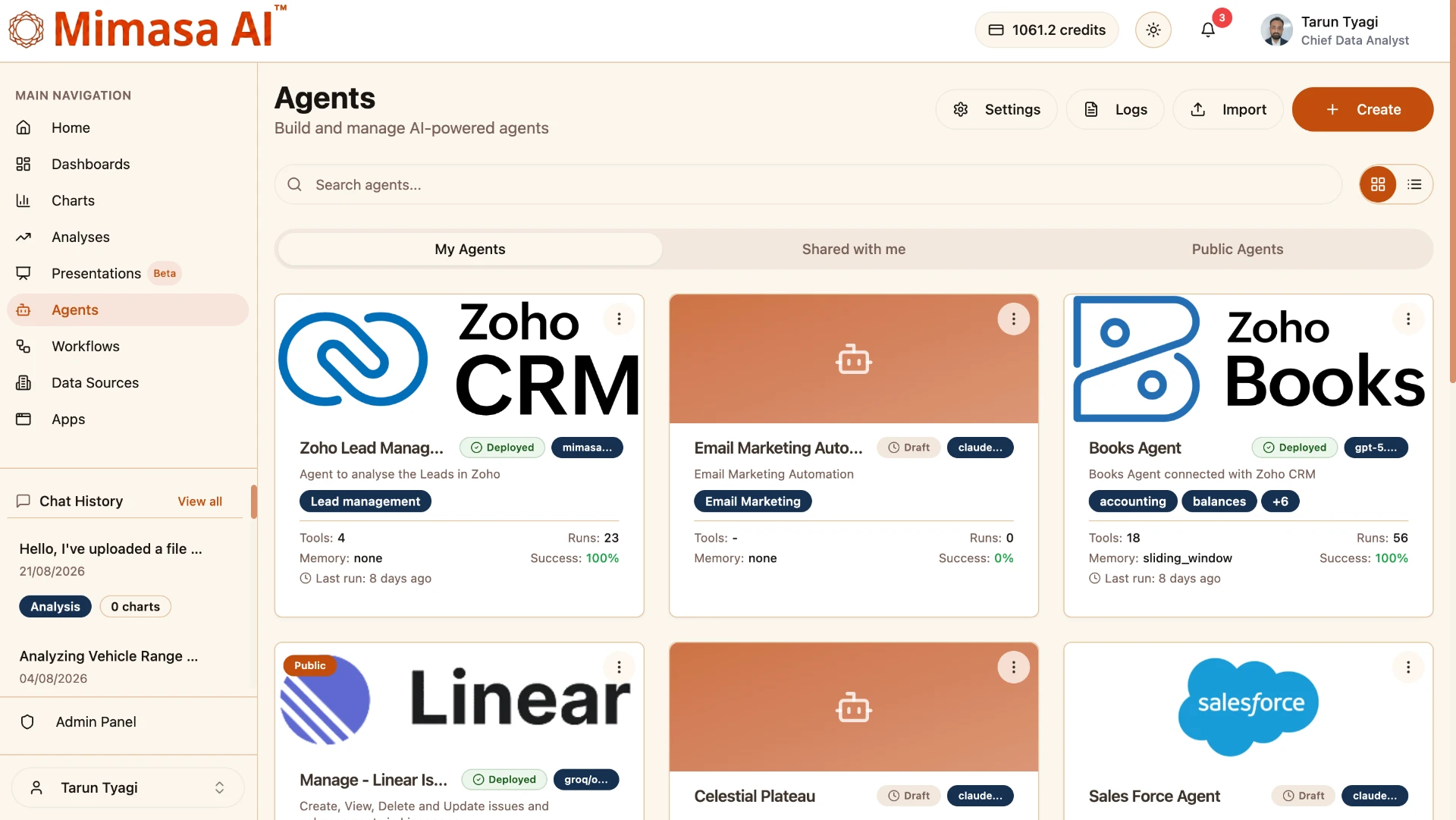
The Mimasa AI agent builder lets teams create purpose-built agents using prompts, reusable skills, enterprise tools, MCP capabilities, integrations and a choice of more than 450 LLMs. Custom AI agents are configured rather than coded, so operations, finance and service teams can shape them around the way work is actually done.
Enterprise AI agents behave as goal-driven systems. They understand the context of a request, analyse enterprise information, select and use the right tools, make controlled decisions, request human approval where policy requires it and complete multi-step tasks end to end. Every run keeps an execution log, so teams can review what an agent read, what it called and what it changed.
Practical roles include finance agents that validate and post invoice data, customer-service agents that resolve enquiries with account context, sales-intelligence agents that prepare account research, inspection agents that assess quality records, and operations agents that monitor exceptions. This is agentic automation applied to defined work: AI agents for business automation that produce an outcome, not just an answer.
Automate Complex Work With Agentic Workflows
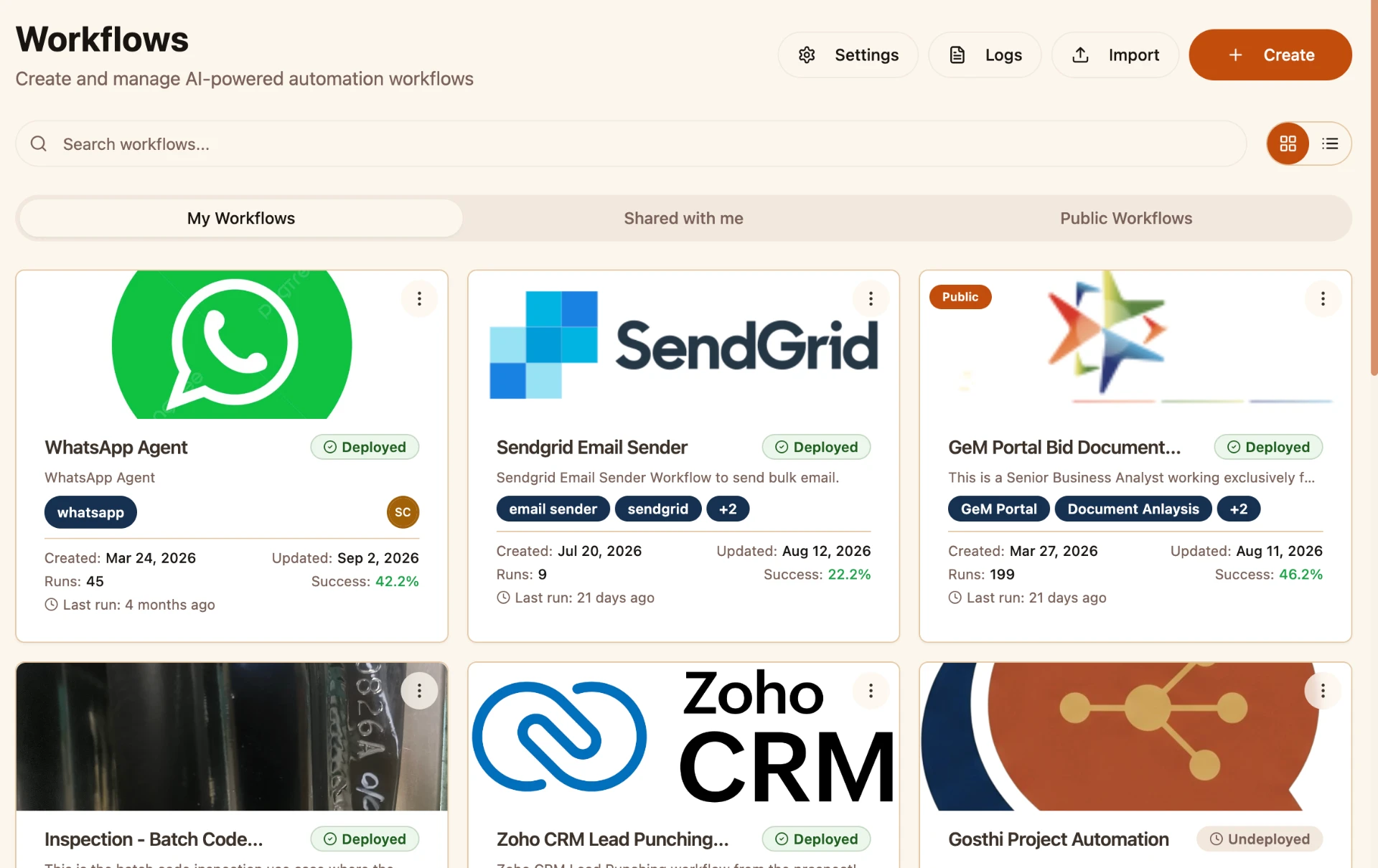
The Mimasa AI workflow builder combines defined business processes with AI reasoning, conditions, triggers, approvals, integrations and actions. It is workflow automation software built for enterprise conditions, where a process spans several systems and rarely runs the same way twice.
Teams construct workflows visually. A workflow can connect enterprise systems, invoke AI models, call business tools, hand a step to a purpose-built AI agent, apply conditions and branching, route exceptions to the right owner, request human approvals and then execute the action in the system of record. Each run keeps a complete execution log with the data used and the decisions taken.
Because the builder is no-code, process owners can adjust logic as policy changes rather than waiting on a development cycle, and technical teams can extend workflows with custom tools and APIs. This is where agentic workflow automation differs from script-based tooling: AI workflow orchestration adapts to the case in front of it while staying inside the rules, approvals and permissions the organisation has set.
Gosthi: The AI Collaboration Platform For People, Projects And Agents
Gosthi is the collaboration layer of Mimasa AI. It brings team conversations, projects, tasks, meetings, AI agents and agentic workflows into one shared workspace, so a decision made in chat becomes owned, executed work instead of a message that scrolls away.
Public and private Bridges keep each team, project or client engagement in its own context. Projects, status sets, subtasks and My Tasks provide the execution layer, meetings start and resume from the relevant thread, and Mimasa agents and workflows can be invoked with an @mention. Clients and vendors can be invited into a single Bridge, so external collaboration never means opening the whole workspace.
Give AI Agents Trusted Enterprise Data
AI automation is only dependable when agents can reach governed, connected and contextually accurate information. The products below form one data foundation: they control who can access what, connect and extract information from enterprise sources, preserve reusable views of it, prepare it for analysis, and turn it into dashboards, reports and presentations that people and agents share.
Data Governance and Collaboration
Govern Data, Access and Collaboration
Data governance software is the control layer for how information is owned, shared and used. Mimasa AI organises data access, ownership and permissions across enterprise teams, so analysts, business users and AI agents work from the same approved sources.
Governed workspaces keep datasets, definitions and outputs together with role-based access, clear ownership and auditability. Collaboration stays secure because access is granted by role rather than by sharing files, and AI-assisted data catalogs help teams find and understand what already exists. The same controls apply to agents, so automation inherits the organisation's access policy instead of working around it.
- Role-based access
- Governed workspaces
- Data ownership and auditability
- Controlled access for agents and people
Data Extraction and Connectivity
Connect and Extract Data From Enterprise Sources
Mimasa AI connects databases, documents, spreadsheets, APIs and enterprise applications, then makes that information available to analytics, agents and workflows. AI-based data extraction reads structured and unstructured sources, so records held in PDFs or scanned documents become usable alongside database tables.
Connectivity is not simply data movement. AI-powered data extraction gives agents and workflows the operational context they need to decide and act — the open invoice, the current stock position, the customer's last three tickets. Data extraction tools that stop at a copy leave that context behind; here the connection stays live for the process that depends on it.
- Databases, files and APIs
- Document and spreadsheet extraction
- Enterprise application connectors
- Context available to agents and workflows
Intelligent Data Snapshots
Create Governed Snapshots of Business-Critical Data
Extraction connects to a source and retrieves information. Intelligent data snapshots do something different: they preserve a controlled, reusable view of relevant information at a particular stage or point in time, so analysis can be repeated exactly.
Governed data snapshots give teams consistent analysis, historical comparison and reproducible reports. They also serve as controlled inputs for AI agents, which keeps an agent's reasoning anchored to an approved dataset rather than a shifting live query. Investigations move faster because the point-in-time data analysis someone ran last quarter can be reopened, and repeated data preparation largely disappears.
- Reusable data views
- Historical comparison
- Reproducible reporting
- Controlled inputs for AI agents
No-Code Data Transformation
Prepare and Transform Data Without Complex Coding
Business and data teams clean, map, combine, enrich and reshape information before it reaches dashboards, reports, agents or workflows. No-code data transformation makes that preparation visible and repeatable instead of hidden in personal spreadsheets.
AI-powered data transformation suggests joins, flags inconsistent values and applies rules across large datasets, while the steps remain reviewable. Enterprise data transformation handled this way shortens data preparation cycles and gives data engineering teams a shared place to standardise logic that many downstream outputs depend on.
- Clean and standardise
- Join and combine sources
- Enrich and reshape
- Reviewable, repeatable steps
Data Visualization and Dashboards
Turn Enterprise Data Into Interactive Dashboards
Teams build interactive dashboards, explore operational metrics, drill into underlying records and generate visualisations from a business question rather than a chart specification. The dashboard creator works on governed data, so a number on screen can be traced to its source.
Common uses include operations monitoring, financial analysis, sales performance, supply-chain intelligence and management reporting. Because data visualization dashboards sit on the same foundation as agents and workflows, a metric that crosses a threshold can trigger a process instead of only changing colour.
- Interactive analytics dashboards
- Drill-down to source records
- AI-powered chart generation
- Shared, governed metrics
Data Insights and Automated Reporting
Generate Insights and Reports With AI
Mimasa AI analyses data, identifies patterns and produces recurring or on-demand reports with narratives, charts and business context. An AI report generator that explains what changed, and why it matters, saves the analyst time normally spent assembling the same pack each cycle.
Automated report generation covers scheduled reports, executive reporting, financial reporting, operational reporting and automated regulatory reporting. As a cloud-based reporting tool it distributes output on a schedule; as part of the platform it can also hand results to a workflow, so AI-powered business reporting ends in an action rather than an attachment.
- Scheduled and on-demand reports
- Narrative plus charts
- Executive and financial reporting
- Regulatory and operational reporting
Data Presentation
Turn Analysis Into Ready-to-Share Presentations
Users convert data, dashboards and generated insights into structured presentations by describing what the audience needs. Natural language based presentation creation produces an outline, an executive summary, the supporting charts and the commentary that connects them.
Reusable organisational templates keep formatting consistent, and every slide stays traceable to the underlying data, so a question in a review can be answered from the source rather than from memory. An AI presentation generator of this kind mainly buys back preparation time before board meetings, business reviews and steering committees.
- Presentation outlines
- Executive summaries
- Charts with supporting narrative
- Reusable organisational templates
One Connected Path From Enterprise Data to Automated Action
Customers can start with one capability and expand without rebuilding their automation foundation. Each stage below feeds the next, and every stage runs under the same governance.
- 1Connect data
- 2Govern and prepare it
- 3Analyse and visualise it
- 4Build AI agents
- 5Orchestrate workflows
- 6Generate reports and presentations
- 7Execute actions with human oversight
Built for Governed Enterprise Deployment
Products Built Around Real Business Operations
Finance and Invoice Processing
Data Extraction reads invoices, Data Governance controls access, AI Agents validate the information, and agentic workflows route approvals and update enterprise systems.
Manufacturing Inspection
Inspection records are extracted and standardised, snapshots preserve the batch view, and agents flag deviations for supervisor approval.
Sales Intelligence
Connected CRM and market data feed agents that prepare account research, while dashboards track pipeline movement.
Customer Service
Service agents retrieve account context, propose a resolution and hand exceptions to a human before any customer-facing action.
Supply Chain and Logistics
Dashboards monitor stock and delivery performance; workflows trigger when a threshold is crossed and update the planning system.
Government and Public-Sector Analytics
Governed datasets and reproducible snapshots support scheme monitoring, with reports generated on a fixed cycle.
Reporting and Compliance
Automated reporting assembles recurring regulatory and management packs, with audit trails showing the data behind each figure.
Enterprise Knowledge and Data Analysis
Teams ask questions of connected data, then turn the analysis into dashboards and presentations for review meetings.
Frequently Asked Questions
Common questions from teams evaluating an enterprise agentic AI platform.
Start With One Workflow. Build an Intelligent Enterprise.
Whether you need to connect fragmented data, build a specialised AI agent or automate an end-to-end business process, Mimasa AI gives your team one governed platform for moving from information to action.