
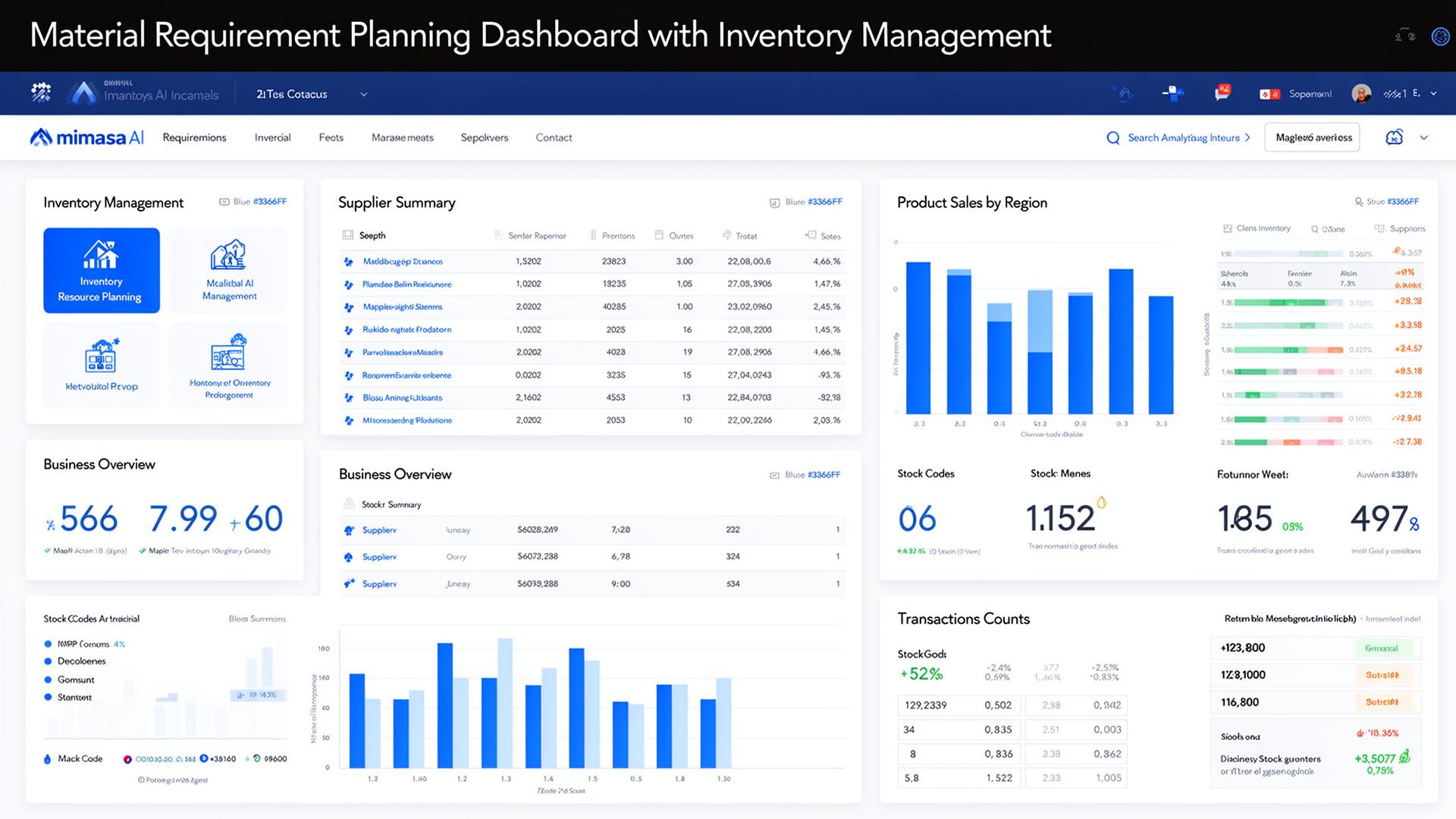
What MRP Really Means in Manufacturing
In real manufacturing environments—packaging, FMCG, industrial goods—MRP is where cash, operations, and customer commitments collide.
Raw Material Availability
Paper, board, polymers, inks, chemicals
Production Scheduling
Capacity planning & optimization
Inventory Levels
Working capital management
Supplier Coordination
Lead time & reliability
Service Levels (OTIF)
On-time in-full delivery
Cash Flow Impact
Working capital optimization
Yet most MRP systems today are:
5 Critical Problems with Traditional MRP Systems
Traditional MRP fails because it operates in isolation—disconnected from commercial reality and unable to adapt to real-time changes.
Forecasts Are Backward-Looking
MRP forecasts based on historical averages, fixed planning cycles, and static assumptions—missing real-time demand shifts, trade promotions, pricing actions, and regional variability.
Overstocking of slow movers. Stockouts of fast movers. Excess working capital locked in inventory.
MRP Is Blind to Commercial Decisions
MRP plans production without knowing which SKUs are actually profitable, which trade schemes will spike demand, or which customers are margin-positive.
Plants run at capacity for low-margin SKUs. High-margin orders are delayed. Profitability and production are misaligned.
Exception Handling Is Manual & Late
Most MRP systems react after damage occurs—late supplier deliveries, sudden demand spikes, production inefficiencies, quality issues.
Firefighting becomes the norm. Planners rely on experience, not intelligence. Decisions happen too late to matter.
Inventory Decisions Lack Intelligence
Inventory policies based on min/max thresholds, safety stock formulas, annual reviews—missing SKU-level risk assessment, cost of stockouts vs overstock, and cash flow impact.
Bloated inventories. Poor cash conversion cycles. CFO frustration.
MRP Lives in Silos
MRP sits inside ERP, disconnected from sales signals, trade promotions, pricing strategies, and external supply risks.
Planning decisions lack context. No single view of supply-demand-profit alignment.
Where Mimasa Fits: MRP Intelligence Layer
Mimasa does NOT replace ERP MRP modules. It sits on top as an AI-powered Planning, Forecasting, and Exception Intelligence layer.
From Static Planning → Continuous Intelligent Orchestration
Mimasa transforms MRP from a periodic planning exercise into a living, breathing intelligence system that continuously adapts to demand, pricing, and supply signals.
Mimasa's MRP Intelligence Flow
Six steps from data ingestion to autonomous planning workflows
Ingest / Extract
No-Code Connectors
Connect to all your data sources without ERP disruption.
Key Capabilities
- ERP MRP tables
- BOM & routing data
- Inventory & WIP
- Supplier lead times
- Sales orders & forecasts
- Trade & pricing signals (from TSP & WSP)
MRP Platform Features and Business Outcomes
MRP Intelligence Business Benefits
Financial
- 15–30% reduction in excess inventory
- Improved working capital cycles
- Better alignment between production and profitable demand
Operational
- Fewer stockouts and rush orders
- Improved OTIF performance
- Reduced planner workload
- Faster response to disruptions
Strategic
- Supply chain aligned with commercial strategy
- Predictable production outcomes
- Leadership visibility into future risks
How MRP Completes the WSP–TSP–MRP Loop
MRP
Executes supply for profitable demand
Mimasa is the intelligence layer that synchronizes all three—continuously.
Material Resource Planning FAQs
Turning MRP From a Planning Chore Into a Decision Engine
Most manufacturing enterprises treat material resource planning as a scheduled batch job that runs overnight and produces a static plan for the week or month ahead. That plan is out of date the moment a distributor places an unplanned order, a supplier reports a delay, or a trade promotion shifts regional demand. Mimasa AI's agentic automation layer treats MRP as a continuously updated decision engine instead, re-evaluating supply and production recommendations as new signals arrive from ERP, sales, and pricing systems.
The underlying challenge is rarely a lack of data. Manufacturers already capture BOM structures, supplier lead times, inventory positions, and sales orders inside their ERP. What is missing is a governed layer that connects those tables to commercial context, so planners can see not just what is running low but which SKUs are actually profitable to replenish first. Mimasa's Data Intelligence Stack builds that connective layer using 180+ connectors, without requiring a rip-and-replace of existing planning software.
Because the platform is LLM-agnostic and deployable on-prem, in a private VPC, or in the cloud, manufacturing IT teams retain control over where sensitive production and supplier data resides while still giving planners a conversational interface to ask questions like which materials are likely to stock out next month. Role-based access keeps sensitive cost and margin data restricted to the right teams, so the same workspace can serve plant managers, finance, and commercial leadership without one group seeing data reserved for another.
Rolling out MRP Intelligence does not require a big-bang replacement of existing planning processes. Most manufacturing teams start with a focused diagnostic scoped to a subset of SKUs or a single plant, connecting existing ERP tables through no-code connectors and validating that the demand-supply mismatch detection and inventory risk scoring reflect what planners already know from experience. That validation step builds trust in the underlying model before it is extended to production scheduling recommendations or automated procurement triggers across the wider network.
Related Industry Solutions
Discover how organizations in similar sectors leverage our AI-powered analytics platform.
Logistics & Transportation
Fleet management, route optimization, and supply chain visibility.
Explore Logistics & TransportationRetail & E-Commerce
Customer analytics, inventory optimization, and sales performance tracking.
Explore Retail & E-CommerceEnergy & Utilities
Grid management, renewable tracking, and customer operations analytics.
Explore Energy & UtilitiesKey Platform Capabilities
Our end-to-end analytics platform powers insights across all industries.