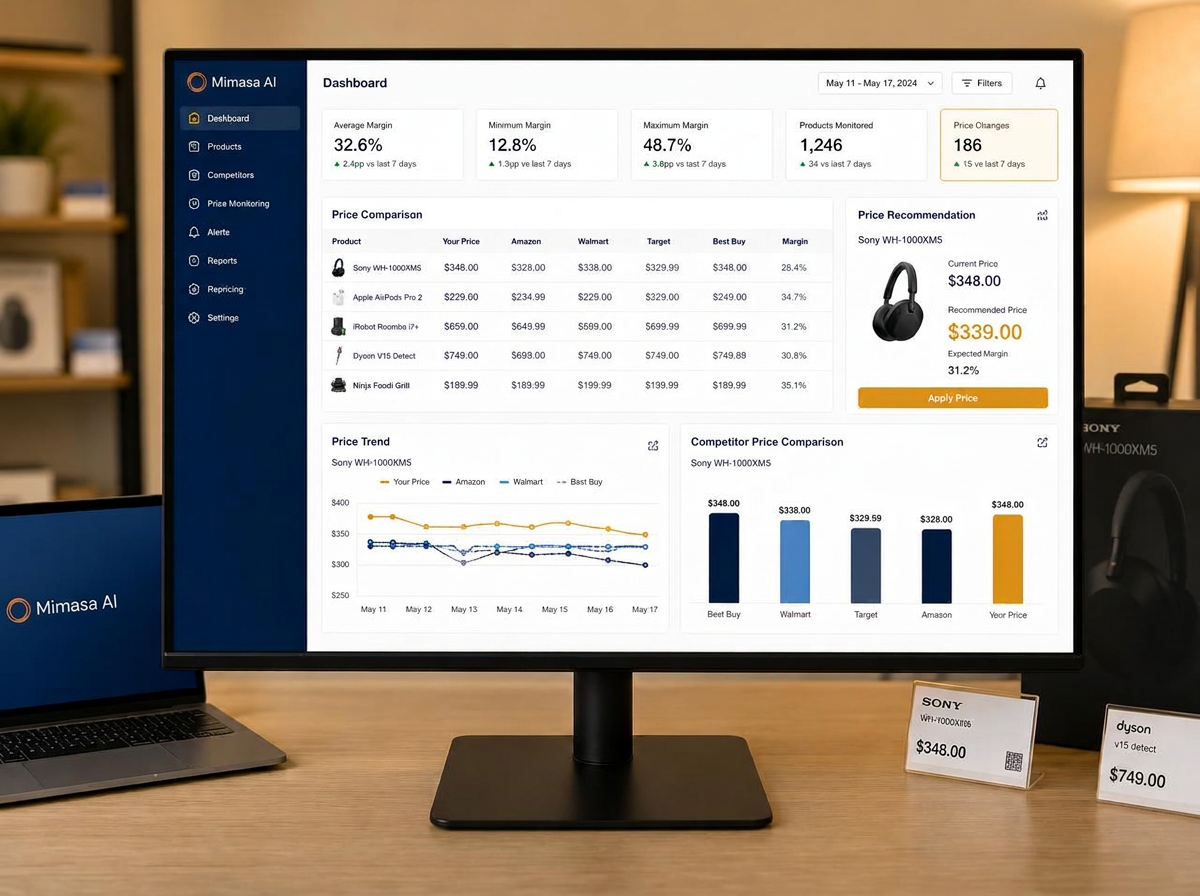
Retail Pricing Intelligence For Smarter Price Optimization
Bring prices, costs, demand, margins, inventory, promotions and competitor data into one governed intelligence layer.
Mimasa AI helps retail and e-commerce teams find pricing opportunities, understand commercial impact and recommend the right action. Pricing agents can monitor signals, explain recommendations and route proposed changes for approval. Make faster pricing decisions without losing control of margins, policies or execution.
Built for pricing teams, category managers, merchandisers, e-commerce teams and retail leaders.
Pricing Context
Make Every Pricing Decision With Better Context
Retail prices cannot be managed through competitor comparison alone. Every decision can affect demand, margin, inventory and customer perception. The right price may also vary by product, store, region, marketplace and sales channel.
Yet the information needed for pricing optimization often sits across POS systems, ERP applications, e-commerce platforms, inventory tools, supplier files and spreadsheets. Teams spend hours combining reports before they can investigate a single pricing question.
Mimasa AI turns this fragmented information into retail pricing intelligence, creating a clearer path from data to decision and from decision to governed action.
Which products are priced above or below the market?
Where are margins falling below the approved threshold?
Which promotions increased contribution, not only sales volume?
Which slow-moving products should be considered for markdown?
Are prices consistent across stores, websites and marketplaces?
Which proposed changes require approval?
Definition
What Is Retail Pricing Intelligence?
Retail pricing intelligence is the process of combining internal commercial data with available market and competitor signals to support better pricing decisions. It provides more context than a basic price monitoring tool: it can connect current prices with product costs, target margins, demand, sales velocity, inventory, promotions and channel performance.
01
Connect relevant retail and e-commerce data
02
Prepare consistent pricing datasets
03
Monitor prices and commercial exceptions
04
Ask pricing questions in natural language
05
Compare products, categories, stores and channels
06
Generate explainable price recommendations
07
Apply margin rules and pricing guardrails
08
Route decisions through approval workflows
09
Send approved actions to connected processes
10
Maintain an auditable record of decisions
Mimasa works with your existing business systems. It does not require you to replace your ERP, POS or commerce platform.
Data To Action
How Mimasa AI Turns Pricing Data Into Action
01
Connect Your Pricing Signals
Bring together data from POS systems, ERP applications, e-commerce platforms, marketplaces, inventory systems, CRM tools, databases, APIs and spreadsheets. The sources used depend on each retailer's systems and implementation.
Current and historical selling pricesProduct costs and margin targetsSales transactions and demand patternsProduct and category hierarchiesStore, region and channel performanceInventory levels and stock ageingPromotion and discount historyCompetitor price feedsMarketplace fees and settlement reportsReturns and cancellation dataSeasonal and event information
02
Create A Consistent Pricing View
Pricing data may use different product codes, formats, category names and reporting periods. Mimasa AI can clean, join, filter, normalize and aggregate this information through natural-language instructions and more than 100 built-in transformation functions. Teams can preserve reusable, governed datasets with Intelligent Data Snapshots — daily competitor positions, weekly category margins, promotion performance or products approaching markdown thresholds.
03
Analyze Pricing In Natural Language
Authorized users can investigate pricing performance without writing SQL. Mimasa converts each authorized question into governed analysis, presented as tables, visualizations, dashboards or structured reports.
“Which products fell below their target margin this month?”
“Compare our price position for the top-selling SKUs.”
“Show promotions that increased revenue but reduced contribution.”
“Which products have different prices on our website and marketplaces?”
“Find slow-moving products with more than 90 days of inventory.”
“Which proposed changes fall outside the approved price band?”
04
Generate Explainable Recommendations
AI agents can evaluate the available signals, objectives and business constraints, then recommend an appropriate next step. Recommendations depend on the quality of available data and configured rules. They are not guaranteed commercial outcomes.
Current and proposed price
Relevant demand and inventory signals
Competitor price position
Cost and margin impact
Applicable pricing rule
Reason for the recommendation
Exception or confidence status
Required approval level
05
Review, Approve And Execute
Retailers decide which actions require human approval. Low-risk changes inside an approved price band can follow a predefined workflow. High-impact decisions can go to a category manager, margin exceptions to finance, and marketplace changes to the appropriate channel owner. Once approved, an action can move into a connected system or execution queue, with a record of what was recommended, approved and changed.
Pricing Capabilities
Price Intelligence Software Built For Retail Decisions
Competitive Pricing Intelligence
Use available competitor data to compare price position by product, category, brand, market or channel.
Important competitor price movements
Products priced materially above or below the market
Price gaps by region or channel
Missing or uncertain product matches
Situations where margin rules should take priority
Competitor data provides context. Mimasa does not assume that the lowest market price is always the right price, which makes the price intelligence tool useful for decisions, not only comparisons.
Margin-Aware Pricing Optimization
Evaluate proposed prices with product costs, commissions, taxes, fees, discounts and target margins.
Identify products where revenue is growing but margin is declining. Find discounts that cross an approved margin floor. See where supplier cost changes have not been reflected in the selling price. This makes product price optimization commercially grounded and easier to govern.
Demand-Aware Price Analysis
Compare historical demand with earlier price movements, promotions and relevant business events.
Teams can review full-price and discounted sales, channel response, regional patterns and performance across comparable products. This provides useful evidence without assuming that price is the only cause of a sales change.
Promotion Intelligence
Understand whether a promotion created meaningful business value.
Compare sales uplift, discount depth, margin and contribution before, during and after a campaign, and analyze results by product, store, region, channel or customer segment. These insights help teams plan future promotions and avoid unnecessary discounting.
Markdown Decision Support
Identify possible markdown candidates using stock ageing, sales velocity, seasonality and inventory exposure.
Merchandising teams can prioritize slow-moving items, end-of-season stock, discontinued lines and location-specific imbalances. Every recommendation can remain subject to minimum-price, margin and approval rules.
Omnichannel Price Monitoring
Monitor prices across stores, brand websites, mobile applications and marketplaces.
Find unintended inconsistencies, promotional conflicts and marketplace exceptions, and compare listed prices with transacted prices where the required data is available. Mimasa supports channel-specific strategies while giving leaders a consistent view of overall pricing performance.
AI Pricing Agents
AI Pricing Agents That Work With Your Team
Mimasa AI agents can monitor defined conditions, investigate exceptions and coordinate the next action.
Competitor Pricing Agent
Monitors available competitor pricing data. It highlights material changes and alerts the responsible category owner.
Margin Protection Agent
Checks proposed prices and discounts against configured cost, margin and price-band rules.
Promotion Analysis Agent
Compares promotion performance across products and channels, then prepares a structured review for business teams.
Markdown Recommendation Agent
Finds relevant ageing or slow-moving inventory and recommends markdown candidates within approved constraints.
Pricing Exception Agent
Detects missing inputs, unusual changes, inconsistent prices or rule violations, and routes the issue to the right team.
Marketplace Pricing Agent
Combines selling prices with available fees, commissions, promotions, returns and settlements to improve channel-level pricing intelligence.
Agents support monitoring and execution. Pricing authority remains governed by the retailer's roles, rules and approval policies.
Across Retail Formats
Retail Pricing Optimization Use Cases
Grocery And Supermarkets
Monitor category prices, supplier cost movements, promotions, margins and store-level differences across frequently changing assortments.
Fashion And Apparel
Use sales velocity, stock ageing, seasonality, size availability and channel performance to support markdown decisions.
Consumer Electronics
Track competitor prices, product lifecycles, marketplace offers and margin pressure across comparable models.
E-Commerce And Marketplaces
Analyze selling price, platform fees, promotions, returns and channel contribution across connected marketplaces.
Multi-Store Retail
Give central teams visibility across locations while supporting governed regional or store-specific pricing decisions.
B2B And Wholesale Retail
Evaluate customer tiers, volumes, contract conditions and margin thresholds before recommending a price or discount.
Pricing Workflows
Move From Price Monitoring To Pricing Workflows
Conventional price monitoring software can show where a price has changed. The operational response may still depend on spreadsheets, emails and manual follow-up. Mimasa connects pricing intelligence with agentic workflow automation.
This makes pricing optimization in retail a repeatable operating process rather than a periodic reporting task.
01Monitor defined price, demand, margin or inventory conditions.
02Detect an opportunity or exception.
03Collect the relevant supporting data.
04Generate a recommendation and explanation.
05Validate it against pricing rules.
06Request approval from the correct owner.
07Send the approved action to a connected process.
08Record the decision for analysis and audit.
Business Value
Benefits Of Retail Pricing Intelligence Software
Make Decisions With Broader Context
Evaluate prices with demand, costs, margins, inventory, promotions and competitor information.
Protect Commercial Guardrails
Apply minimum margin, price-band, discount and approval rules before an action proceeds.
Respond Faster
Use monitoring and automated alerts to find pricing exceptions without waiting for the next manual report.
Reduce Spreadsheet Work
Let authorized teams investigate prices through natural-language questions and reusable analysis.
Improve Promotion Accountability
Compare sales growth with margin and contribution to understand the real value of a promotion.
Coordinate Omnichannel Pricing
Create a governed view across physical stores, owned digital channels and third-party marketplaces.
Security And Governance
Secure And Governed Retail Pricing
Pricing data can contain sensitive costs, margins, supplier terms and promotion plans. Access can be limited by product, category, region, channel or commercial field. Deployment options depend on the retailer's security and data-residency needs.
Role-based access controlGoverned data workspacesHuman approval stagesAudit trails for pricing workflowsControlled sharing of datasets and reportsEnterprise model choiceCloud deploymentPrivate-cloud or private-VPC deploymentOn-premise deployment
Connected Platform
One Platform For Pricing Intelligence And Action
Mimasa combines the capabilities required across the pricing process.
Clear answers about pricing intelligence, competitor data, promotions, markdowns, governance and deployment.
Retail pricing intelligence software combines pricing, cost, demand, margin, inventory, promotion, and market data to support better pricing decisions. Mimasa AI adds natural-language analysis, AI agents, and governed workflows to this process.
Price monitoring tracks price movements. Price intelligence connects those movements with commercial context such as costs, demand, margins, and inventory. It helps teams understand what a change means and decide what to do next.
Mimasa can send approved actions into connected workflows or systems. Retailers decide which changes can proceed automatically and which require human review.
Mimasa can analyze competitor data supplied through approved feeds, files, APIs, or connected sources. Availability and accuracy depend on the sources included in the implementation.
Mimasa can support dynamic pricing processes by monitoring changing signals, generating recommendations, and routing approved actions. Update frequency depends on data availability, integrations, and governance requirements.
Yes. Authorized users can ask pricing questions in natural language and receive governed tables, dashboards, visualizations, or reports.
Yes. Teams can compare discounts, sales, margins, and contribution. They can also identify possible markdown candidates using available inventory, ageing, and sales information.
Yes. It can combine marketplace prices with available commissions, fees, promotions, returns, settlements, and product costs.
No. Mimasa provides an intelligence, agent, and workflow layer across existing systems. It does not require retailers to replace their ERP, POS, or commerce platforms.
Yes. Mimasa supports cloud, private-cloud or private-VPC, and on-premise deployment options based on enterprise requirements.
Turn Retail Pricing Intelligence Into Governed Action
Connect price, demand, margin, inventory, promotion and competitor signals in one pricing intelligence platform. Give your teams faster answers, explainable recommendations and controlled workflows from analysis to approved action.
See how Mimasa AI can work with your retail systems, pricing rules and approval process.