
Data Intelligence
Connect, govern, transform and analyze structured or unstructured information. Ask questions in natural language and create traceable dashboards, reports and presentations.
Mimasa AI connects enterprise data, AI agents, intelligent workflows and people in one governed platform. It understands what needs to happen, coordinates approved tools and systems, involves people when judgment is required, and turns trusted information into completed work.
Start with one process. Expand across teams without replacing the systems you already use.
Explore The Platform Architecture180+ Integrations · 450+ LLMs · Human-In-The-Loop · Cloud, Private Cloud Or On-Premise
Governed Intelligence
An enterprise AI platform connects organizational data, models, agents, workflows, controls and business systems in one operating environment. It helps teams move beyond isolated AI answers and apply intelligence to real processes.
Connect, govern, transform and analyze structured or unstructured information. Ask questions in natural language and create traceable dashboards, reports and presentations.
Give agents a defined role, instructions, skills, context and approved tools. They can work toward a goal and adapt their next action using the result.
Coordinate predictable processes with triggers, rules, branches, reusable actions, agents and approval stages.
Bring people, projects, conversations, tasks and AI agents together in Gosthi so reviews, decisions and follow-up stay connected.
Together, these capabilities make Mimasa more than an AI agent platform or data intelligence platform. They create an enterprise automation platform that can understand, decide and act within defined controls.
Mimasa works through a governed operating loop. It gathers permitted context, coordinates reasoning and workflows, validates the result, involves a person where required, completes the authorized action and records the outcome.
Bring permitted enterprise data and systems into the process.
Connect databases, ERP and CRM systems, cloud storage, email, APIs, spreadsheets, documents, images, video streams and internal applications. A request, event or data change can begin a run, and authorized results can be written back where work happens.
Connect Enterprise Data With MimasaTurn raw inputs into trusted, permitted business context.
Mimasa extracts fields, maps schemas, cleans records, resolves entities and applies shared definitions. Governed datasets retain ownership, metadata, access rules and lineage so people and agents receive only the context they are permitted to use.
Govern Enterprise DataInterpret the goal and choose the right execution pattern.
Mimasa assembles relevant instructions, skills, memory, rules, prior state and authorized data. It determines whether the work needs a predictable workflow, an adaptive agent or both—combining process control with reasoning where context changes the next step.
Build Purpose-Specific AI AgentsCoordinate agents, workflows and approved tools.
AI agent orchestration turns a goal into traceable actions rather than a single response. An agent may query data, extract a document, apply a rule, call an API, generate a report or update a system while the workflow controls sequence, branches, retries and exceptions.
Create Agentic WorkflowsCheck results and involve people when judgment is required.
Required fields, schemas, business rules, confidence thresholds and reconciliation results can be checked before an action is committed. Missing information, sensitive decisions and exceptions move to an authorized person with their context and evidence attached.
Collaborate In GosthiDeliver the approved outcome where work happens.
Mimasa can deliver an approved outcome as an updated record, completed task, routed document, alert, response, dashboard, report, spreadsheet or presentation. People and agents can coordinate follow-up work without losing the evidence behind the decision.
Generate Insights And ReportsMonitor every run and improve with evidence.
Authorized teams can review status, duration, model and tool usage, inputs, outputs, decisions, approvals, failures and cost. Execution traces reveal where a process slows, an agent needs better instructions or another stage is ready for automation.
Review The Technical ArchitectureAI agent orchestration coordinates agents, tools, data and workflow steps around a shared outcome. It determines what runs, in which order, with what context and under which controls.
One purpose-specific agent chooses between approved tools to complete its goal.
Agents handle interpretation while the workflow controls sequence, deadlines, approvals and system actions.
Where several roles add value, specialized agents complete different tasks and hand structured outputs to the next stage.
Enterprise AI orchestration never means unrestricted autonomy. Every agent operates within assigned tools, permissions, data access and approval policy.
AI agents for business automation are purpose-specific digital workers that understand a goal, use approved tools and continue until they complete the outcome or require human help. Unlike a chatbot, an agent can act. Unlike rigid automation, it can evaluate a result and adapt the next step.
Explore The AI Agent Builder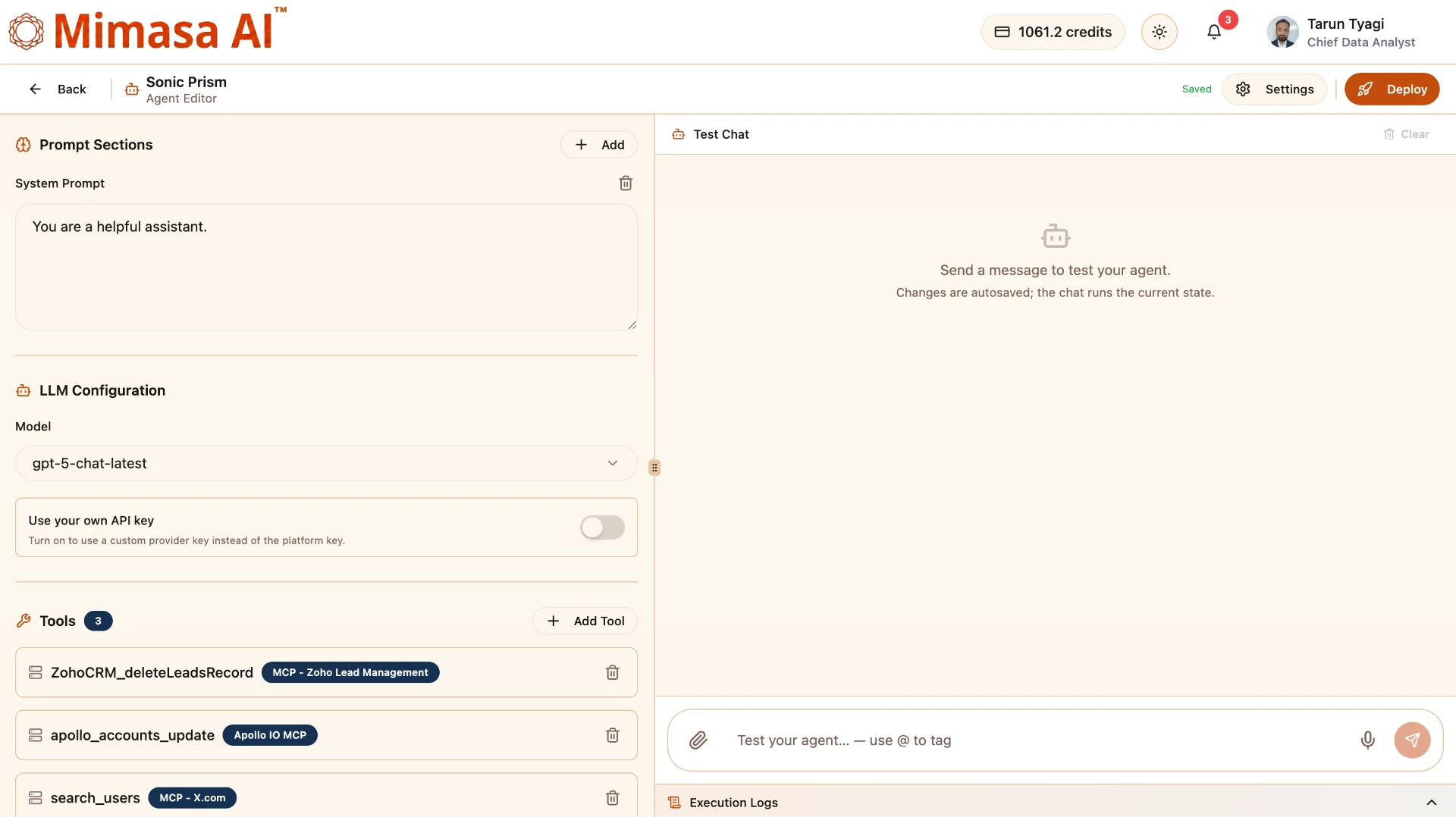
Extract documents, compare records, investigate exceptions, prepare entries and route approvals.
Research accounts, qualify leads, update records, prepare follow-ups and recommend the next action.
Monitor production, inventory, inspections or operational events and coordinate controlled responses.
Gather information from approved sources, analyze evidence and deliver a structured report.
Understand a request, retrieve permitted information, complete routine actions and escalate exceptions.
Intelligent workflow automation combines predictable process control with AI that can interpret information and handle variation. Agentic AI workflows add reasoning where a document, message or exception cannot be handled through fixed rules alone.
| Workflow Automation | AI Agent | Combined In Mimasa |
|---|---|---|
| Follows a designed sequence | Works toward a goal | Uses the right pattern at each stage |
| Uses triggers, conditions and branches | Chooses approved tools | Keeps adaptive work inside a controlled process |
| Best for repeatable steps | Best for changing context | Supports end-to-end AI business process automation |
| Exceptions follow configured paths | Reassesses using results | Routes uncertain cases to people |
Human-in-the-loop automation lets AI complete routine work while people retain authority over sensitive, uncertain or high-impact decisions. Organizations can begin with frequent review and narrow approvals as data quality, controls and confidence improve.
AI analyzes or drafts; a person acts.
A person approves defined stages.
Routine cases continue; exceptions go to people.
An agent completes an approved goal within limits.
Enterprise AI governance controls what an agent can access, decide and do. In Mimasa, governance is part of execution rather than a report added afterward.
Users and agents operate within assigned permissions and approved data scope.
Tools, rules, thresholds and approval requirements define agent boundaries.
Data, calculations and decisions stay connected to source context where the process supports it.
Teams can inspect steps, inputs, outputs, tool calls, decisions and approvals.
Use managed cloud, private cloud/VPC or on-premise according to residency and infrastructure needs.
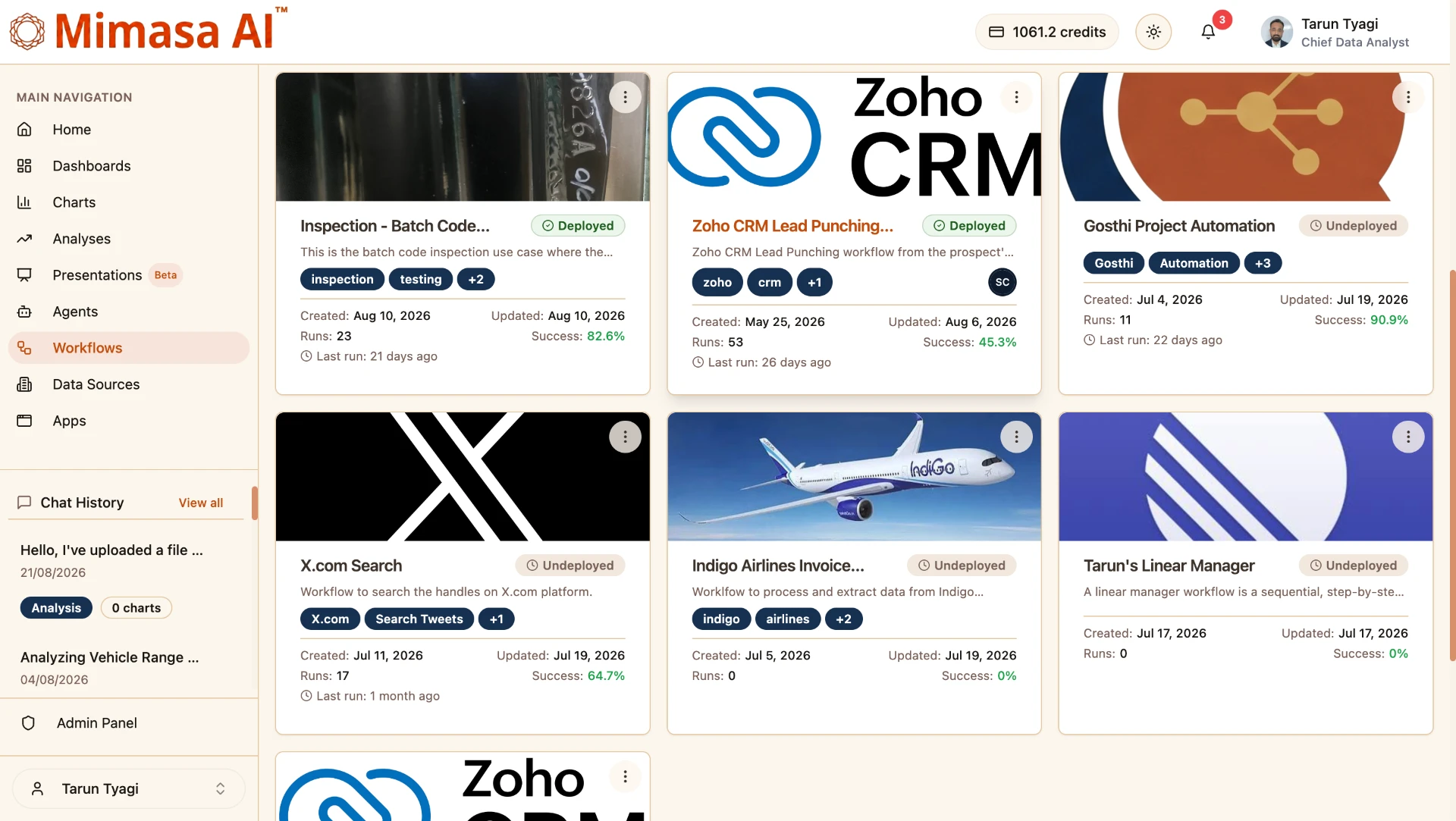
An AI agent management platform must show more than deployed agents. Teams need to know what is running, who owns it, which tools it can use and how it performs. Authorized users can review deployment status, run history, success or failure, duration, usage, cost and step-level traces.
Ask questions, upload files, review exceptions and receive completed outcomes in natural language.
Design workflows, define rules, assign approvals and monitor performance.
Connect sources, transform information, define metrics and prepare trusted context.
Extend the platform through APIs, custom tools and MCP while controlling credentials, access and observability.
Track adoption, operating outcomes, exceptions and control across teams.
An enterprise AI transformation need not begin with a company-wide rollout. Start with one repetitive, data-heavy or slow process where the outcome can be measured.
Explore Enterprise AI Automation Use CasesChoose the task, users, systems, rules and success measures.
Bring in only the information and applications required.
Configure the workflow, agent, tools and expected outputs.
Set approval stages to match the process risk.
Monitor quality, exceptions, time and cost.
Refine the path, then reuse the governed foundation.
Extract invoices, purchase orders, bid documents and PDFs. Validate information, route exceptions and update downstream systems.
Explore AI Invoice Processing AutomationConnect files and databases, ask questions in natural language and deliver dashboards, reports or presentations.
Explore Self-Service Data AnalyticsConnect ERP, production, quality, inspection and supply-chain signals. Detect issues and coordinate controlled responses.
Explore Manufacturing And Supply Chain AIUnderstand images, video and operational events. Combine detected evidence with alerts, workflows and human review.
Explore Video Intelligence And AnalyticsStraight answers about enterprise AI platforms, agents, orchestration, governance and human control.
Bring one process, one data challenge or one operational bottleneck. We will show how Mimasa can connect the context, coordinate agents and people, and turn it into a governed workflow with measurable execution.
Review The Platform Architecture