
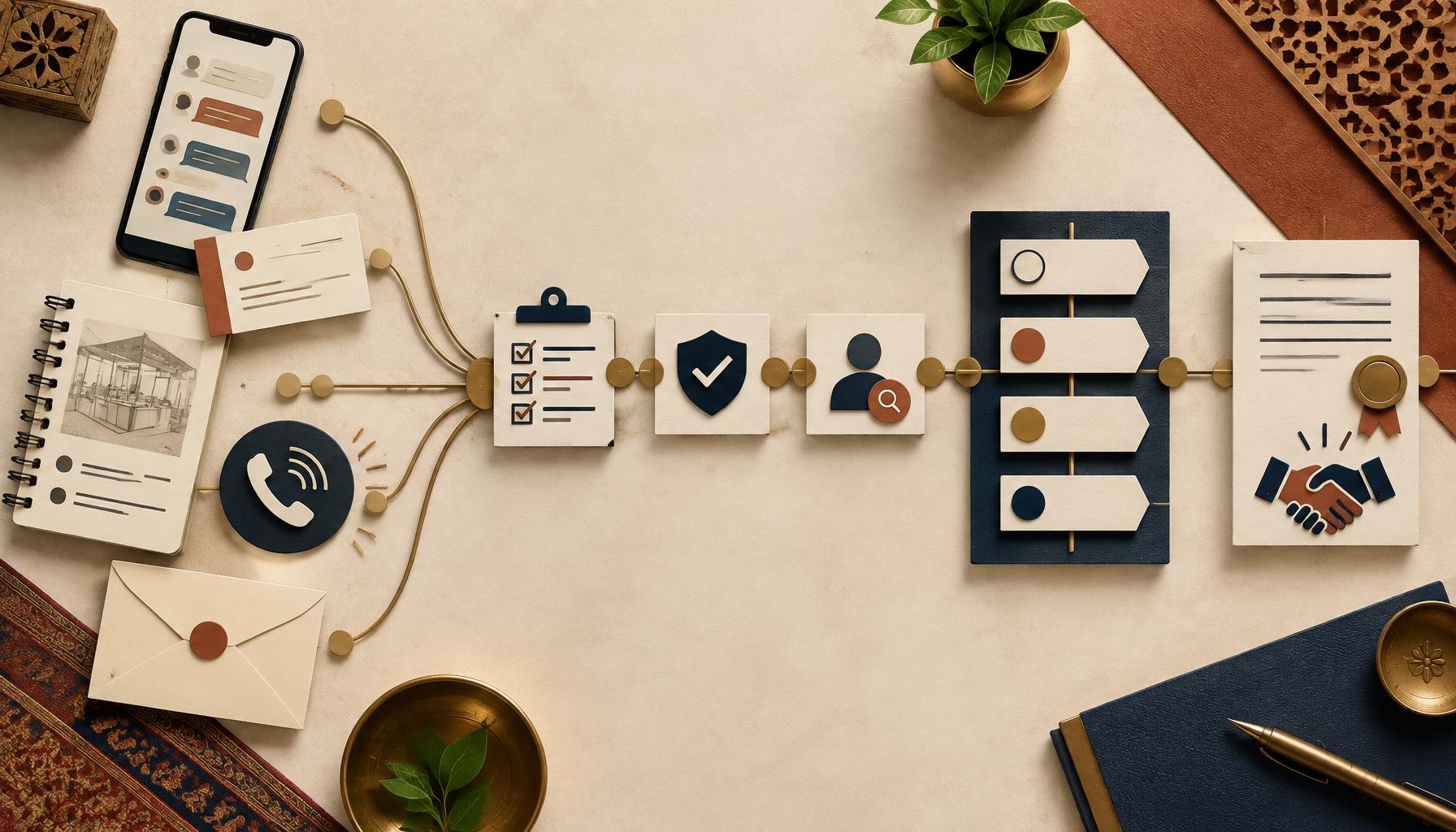
An Indian MSME rarely loses a deal because nobody worked hard enough. It loses the deal in the gaps between work.
A buyer calls while the owner is at the factory. A visiting card returns from an exhibition in a shirt pocket. An IndiaMART enquiry reaches a shared inbox. A salesperson sends a voice note to a manager. Everyone intends to follow up, but the day moves faster than the process.
By the time someone asks for an update, the buyer has already received two quotations elsewhere.
This is the real opportunity for AI sales automation in India's MSME sector. It is not about replacing the salesperson. It is about removing the pauses, re-entry, and memory-dependent tasks that sit between a promising conversation and the next useful action.
Why MSME Sales Is Harder Than It Looks
Large companies can divide sales operations across lead generation, inside sales, field sales, sales operations, customer success, and revenue operations. In a smaller business, two or three people may carry all six responsibilities.
The same person who qualifies an enquiry may also prepare a quotation, chase dispatch, resolve a payment question, visit a distributor, and report the pipeline to the owner. A CRM does not solve this by itself. It works only when useful information reaches it promptly and consistently.
India's MSME base also operates at enormous scale. A March 2026 Press Information Bureau release reported 7.83 crore cumulative Udyam and Udyam Assist registrations as of 28 February 2026. That figure is date-specific, but it shows the size and diversity of the sector.
PwC India and the Observer Research Foundation's Unlocking the AI Edge for MSMEs estimates that AI could add roughly US$135.6 billion to US$149.9 billion to manufacturing MSME value creation by 2035. It is a manufacturing-wide estimate, not a sales automation result, but it underlines why practical adoption matters.
What The Wider Sales Research Tells Us
The strongest evidence does not say that one tool guarantees growth. It says teams are recovering time and improving execution when they use AI in real sales work.
ZoomInfo's 2025 State of AI in Sales and Marketing, based on more than 1,000 go-to-market professionals, reports that AI users see 47% higher productivity and save an average of 12 hours a week. The survey is not specific to Indian MSMEs, so the useful lesson is directional: repetitive sales work has measurable time costs.
Salesforce's State of Sales, Sixth Edition findings report revenue growth among 83% of sales teams using AI, compared with 66% of teams without it. This is an association from a global survey, not proof that AI alone caused the growth.
LinkedIn's 2025 ROI of AI research says 56% of sales professionals use AI daily and daily users are twice as likely to exceed their targets. Again, the result supports disciplined adoption rather than a universal promise.
The common thread is simple. Automation becomes useful when it changes the process after an enquiry, not when it merely creates more information.
The Six-Step Sales Automation Sequence
The best starting point is one connected sequence. Each step should have an owner, a permitted action, a stopping rule, and a measurable baseline.
- 01
Capture
Collect the enquiry while its context is still fresh.
- 02
Validate
Check configured fields and surface uncertain values.
- 03
Prioritise
Route by declared need, fit, timing, and review rules.
- 04
Follow Up
Run approved sequences and pause when a buyer replies.
- 05
Review
Give the owner a clear daily view of action and risk.
- 06
Retain
Monitor approved renewal dates and customer commitments.
Step 1: Capture Every Lead When It Appears
The first loss happens before qualification. A lead exists in a call log, email, WhatsApp message, voice note, visiting card, exhibition notebook, or marketplace enquiry, but not in the sales system.
Good MSME sales automation meets the salesperson at the point of work. A field rep can speak a short note. A card image can provide printed contact details. An approved message can be parsed for configured fields. Sales Lead Punching Automation can structure that input, validate it, check for duplicates, and prepare an authorised CRM action.
It should never guess silently. An uncertain company match, phone number, quantity, or timeline must return to a person for confirmation. The CRM remains the system of record.
Step 2: Respond Before The Buyer Moves On
A fast response does not need to pretend that a full sales conversation has happened. It can acknowledge the enquiry, confirm what was received, request one missing detail, and set a realistic expectation for the next human response.
For example, an approved workflow can acknowledge an email or marketplace enquiry, assign an owner, and create a follow-up task. A messaging response should use approved templates and consent rules. It should not invent stock, price, delivery dates, or commercial commitments.
This distinction matters. Speed is useful. Unsupported certainty is not.
Step 3: Separate Buying Intent From Casual Interest
Not every enquiry deserves the same response path. A buyer with a defined quantity, delivery window, location, and decision process is different from someone collecting an indicative price.
Lead scoring should make its criteria visible. It can use declared requirements, completeness, fit, urgency, and engagement. High-priority leads can move to a salesperson quickly. Incomplete records can enter a clarification path. Low-confidence classifications should be reviewed rather than treated as fact.
Agentic AI sales is valuable here when a governed agent connects the score to a real action: route, request information, create a task, or stop and ask for review.
Step 4: Follow Up Without Depending On Memory
Many B2B deals are not lost after the first call. They are lost after the third forgotten follow-up.
A simple sequence might prepare an approved Day 1 summary, a Day 3 reminder, a Day 7 check-in, and a Day 14 nurture message. The exact timing should follow the business's sales cycle. The sequence must pause when the buyer replies, opts out, changes status, or needs human attention.
The salesperson still decides how to handle negotiation, objections, and relationship nuance. Agentic Workflow Automation keeps the agreed process moving and records what happened.
Step 5: Give The Owner A Daily Pipeline Picture
Small-business owners do not need another dashboard to inspect. They need a short list of decisions and risks.
A useful daily summary can show newly captured leads, enquiries without owners, deals with no activity for five days, quotations awaiting action, and follow-ups due today. Each item should link back to its source and current record.
This is where intelligent automation for an MSME becomes management infrastructure. It turns scattered activity into an evidence trail that the owner can act on.
Step 6: Protect Revenue Already Earned
Sales process automation in India should not stop when the first invoice is raised. Many MSMEs depend on repeat orders, annual maintenance contracts, dealer relationships, and renewals.
An approved workflow can monitor contract dates, service milestones, renewal windows, open issues, and inactivity. It can prepare a task before a customer becomes an urgent recovery case. People still decide the offer and conduct the relationship conversation.
Retention work is often less visible than acquisition, but it protects the revenue base that funded the next sale.
A Connected Sales Process
Enquiry → Structured Record → Validation → Priority → Approved Response → Human Conversation → Follow-Up → Renewal Signal
Every arrow needs a permitted action, an accountable owner, and a review path for uncertainty.
Why The Effect Compounds
One faster acknowledgement is useful. A connected sequence is more valuable because each step improves the next.
Better capture improves qualification. Better qualification improves routing. Better routing makes follow-up more relevant. Reliable follow-up creates cleaner pipeline signals. Cleaner signals help the owner allocate attention. Renewal monitoring protects relationships that could otherwise go quiet.
A May 2026 Gartner survey found that sales organisations providing AI-enabled next-best-action guidance were 2.6 times more likely to achieve commercial growth. The survey was fielded in 2025 and does not prove a guaranteed outcome for every MSME. It does support the value of connecting guidance to the next useful action.
Three Objections Worth Taking Seriously
“Our Sales Depends On Personal Relationships”
That is a reason to automate administration, not relationships. The salesperson should spend more time understanding the buyer, resolving uncertainty, and negotiating. Software can handle approved capture, checking, routing, and reminders around that work.
“We Tried A CRM And Nobody Used It”
Adoption often fails because the CRM asks people to repeat work after the useful moment has passed. Voice capture, card extraction, email parsing, and simpler field requirements can reduce that burden. Data Extraction helps convert approved documents and images into structured inputs, but validation and review remain essential.
“Automation Sounds Expensive And Complex”
It can be, especially when a business tries to automate the entire revenue cycle at once. A safer approach is to start with one measurable leak. Count unlogged enquiries, measure first-response time, or identify overdue follow-ups. Prove value in that process before expanding.
Do not accept universal promises about implementation speed or returns. Cost and timing depend on data quality, integration scope, permissions, message channels, and team adoption.
One Connected Layer, Not Another Silo
Mimasa AI connects the human workforce, governed agent workforce, enterprise data, and approved applications around a defined process.
For an MSME sales workflow, that can include field lead capture from voice notes and visiting card scans, approved acknowledgements, transparent qualification rules, follow-up sequences, daily pipeline intelligence, and renewal monitoring. Work can be coordinated inside Gosthi, while AI Agents operate within assigned tools, permissions, and stopping rules.
The connected CRM, ERP, email service, or other approved application remains authoritative. Mimasa provides the intelligence, orchestration, and execution layer above those systems. Commercial judgement stays with people.
The Bottom Line
Indian MSMEs do not need automation because their teams lack effort. They need it because a small team carries too many transitions by hand.
The practical route is not a large transformation programme. Start with one measurable sales process. Capture the enquiry at its source. Validate before writing. Respond through approved rules. Keep follow-up moving. Show the owner where attention is needed. Then measure the difference.
AI for small business in India becomes valuable when intelligence reaches execution. The outcome is not a salesperson replaced by software. It is a salesperson arriving at the next conversation with better context and fewer forgotten actions behind them.