
My first sales manager gave me one rule: follow up every three days until they reply.
It worked, until a buyer wrote back, very politely, to say she had told me "after the board meeting". I had emailed her four times before it.
I didn't need a better rule. I needed to remember what every buyer had told me, across dozens of leads, every single day.
That is exactly the job an AI sales assistant is good at.
This guide covers what an AI sales assistant does for follow-ups, the cadence framework it should follow, a sample 30-day plan after a proposal, and how to choose one for your team.
What Is An AI Sales Assistant?
Definition
An AI sales assistant is software that helps a salesperson complete a task. It can summarise a lead, find information, work out what's due and draft the next message. The salesperson reviews the work and makes the final call.
For follow-ups, an AI sales assistant has three jobs:
Remember
Every lead's context: what they said, what you promised, when they asked you to come back.
Decide
What's due today, and give the reason for each lead.
Draft
A follow-up that picks up from the last real conversation, ready for you to approve.
People often mix up assistants, sequences and agents. They work very differently for follow-ups:
| Email sequence | AI sales assistant | AI sales agent | |
|---|---|---|---|
| How it times follow-ups | Fixed days set in a template | From the buyer's dates, questions and replies | Works through approved steps on its own |
| What it writes | The same template for everyone | A draft built on each lead's history | Messages within its assigned tools and limits |
| Who decides to send | The tool, automatically | You, one by one or as a batch | Depends on its permissions |
| When the buyer replies | The sequence stops | The draft pauses and the context refreshes | It moves to its next step |
| Best for | Cold outreach at volume | Leads you're already talking to | Narrow, repetitive back-office tasks |
For customer follow-ups, the assistant pattern is usually the right one. Your name is on every email, and the relationship is yours. Many AI agents for sales can work this way too, as long as a person approves each external message.
What Is A Sales Follow-Up Cadence?
Definition
A sales follow-up cadence is the timing and order of the messages you send a lead between one conversation and the next: when you reach out, on which channel, and what each message adds.
People often use "cadence" and "sequence" as if they mean the same thing. They don't, and the difference matters for B2B sales.
| Sales sequence | Sales follow-up cadence | |
|---|---|---|
| What it is | A fixed set of messages, sent on set days | A rhythm that adjusts to each lead |
| Who sets the timing | The tool or the template | The buyer, then your team's rules |
| Best for | Cold outreach to many people at once | Leads you are already talking to |
| What happens on a reply | The sequence stops | The next step changes |
| Main risk | Sounding like a robot | Forgetting what the buyer said |
A sequence is a cadence written in advance. That works when you know nothing about the person yet. Once a buyer has spoken to you, the cadence should come from what they said, not from a template.
Why "Every 3 Days" Breaks In B2B Sales
A fixed interval breaks in B2B because most of the buying happens when the buyer isn't talking to you.
Gartner's research on B2B buying found that buyers spend just 17% of their buying time meeting potential suppliers. Split across three suppliers, each one gets about 5%. The rest of the time, they are reading, comparing and meeting internally.
17%
of B2B buying time is spent meeting potential suppliers, about 5% each across three.
Gartner, B2B buying research
~7x
more likely to qualify a lead when responding within an hour versus waiting even one more hour.
Oldroyd, McElheran and Elkington, HBR, 2011
So when a buyer says "let me discuss with my team", that internal discussion is the main event, not a gap in your calendar. A reminder every three days doesn't speed it up. It just shows you weren't listening.
Fixed intervals cause three problems:
Too early.
You follow up before the date the buyer gave you, so the message adds nothing.
Too generic.
Because the timing came from a template, so does the message. "Just checking in" is what a calendar writes.
Too late.
A hot lead waits three days for a reply it needed today.
That third one is costly. A Harvard Business Review study of online leads found that companies that responded within an hour were nearly seven times as likely to qualify the lead as those that waited even one more hour. Speed matters most when interest is fresh.
The fix isn't a better number. It's letting the buyer set the timing, and having something that remembers that timing for every lead. That's the job an AI sales assistant does best.
Cold Email Cadence Vs Sales Follow-Up Cadence
Cold email and sales follow-up need different cadences, because one is earning a first reply and the other is moving a deal you already have.
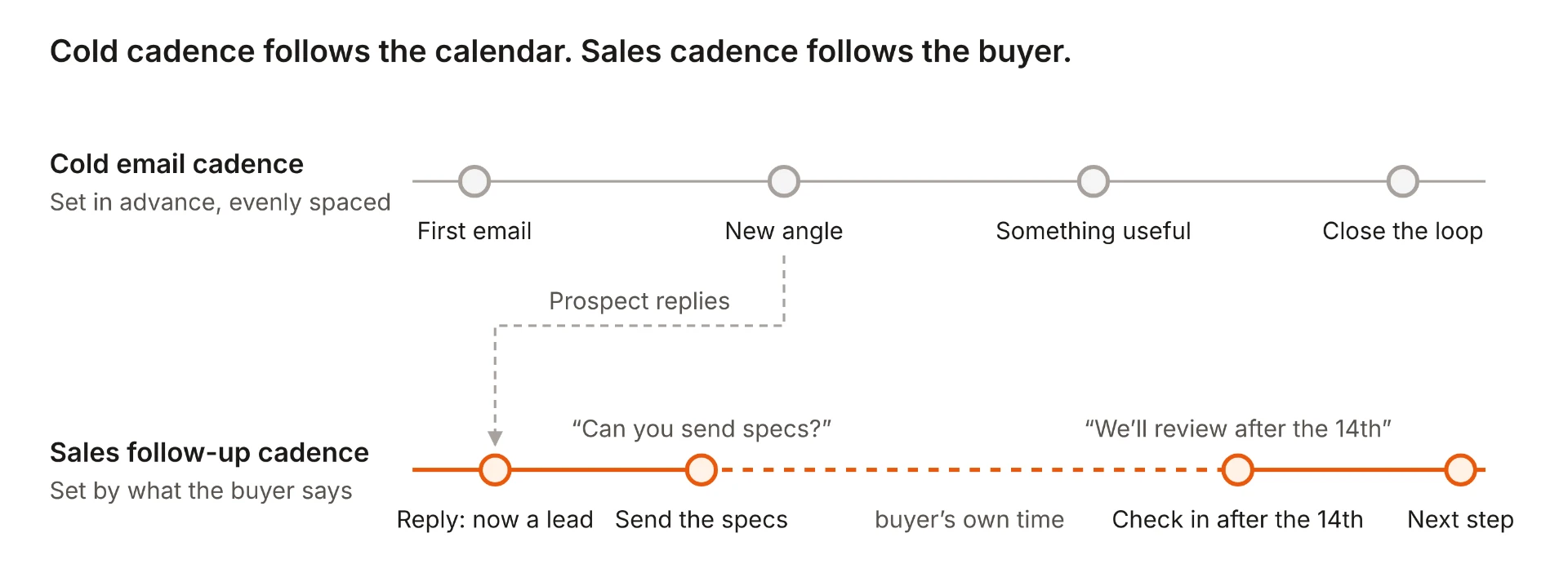
A cold cadence is evenly spaced because you know nothing about the prospect yet. Once they reply, they become a lead, and the gaps start to follow what they tell you: fast when they ask for something, patient while they review.
Cold Email Cadence
A short sequence written in advance. Each message adds a new angle or something useful. Three or four touches is common, then you close the loop.
Sales Follow-Up Cadence
Uneven by design. It moves fast when the buyer asks a question, waits when they are reviewing internally, and always picks up from what they said last.
The handover between the two is where leads get lost. When a cold prospect replies, their sequence has to stop straight away. They need a real conversation now, not "follow-up 3 of 4". For cold email examples, see our guide to the follow-up email after no response.
How An AI Sales Assistant Decides When To Follow Up
A good AI sales assistant asks four questions, in order, every time a lead comes due. Only when all four answers are "no" does your team's default rhythm take over.
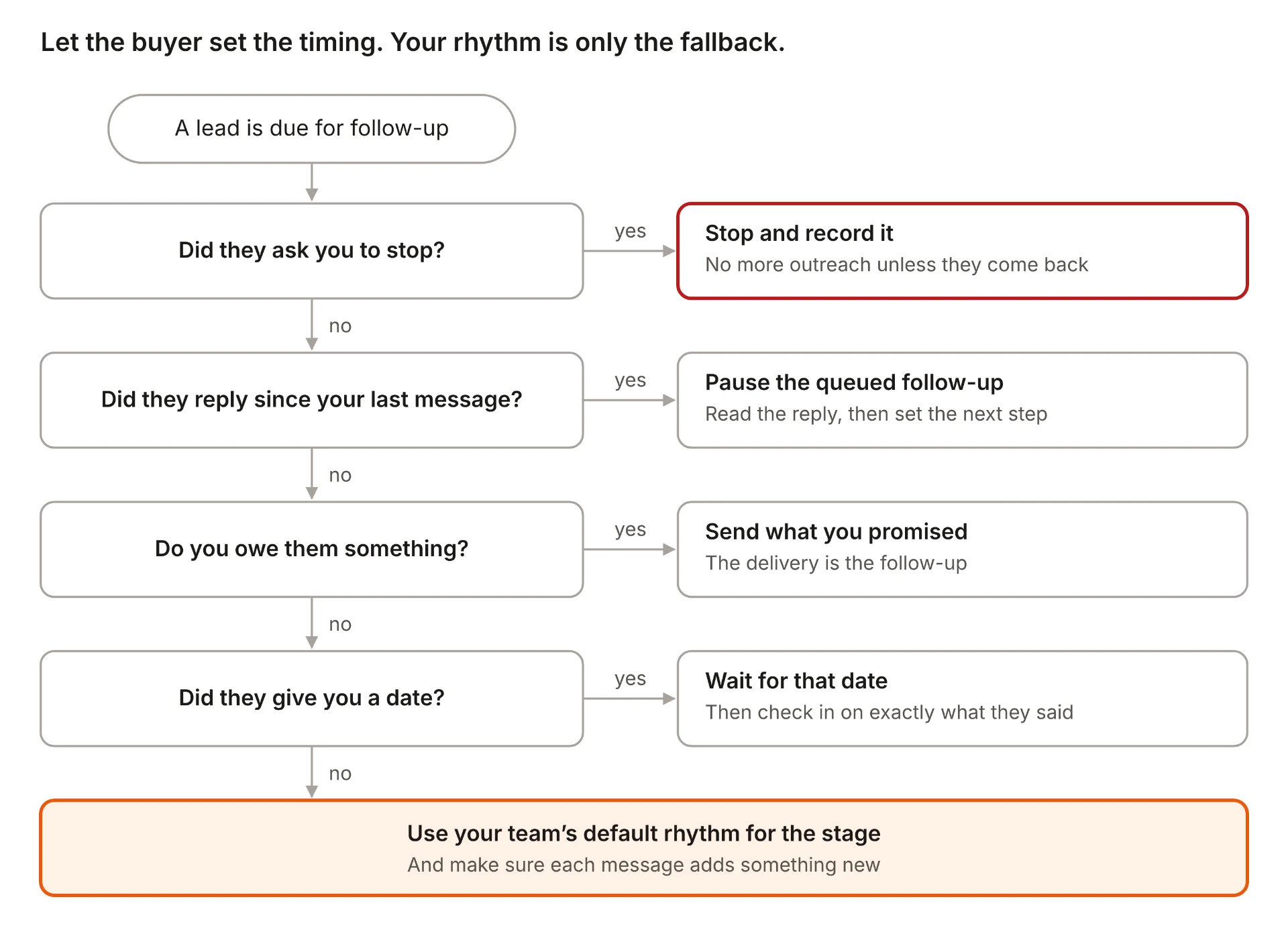
Run these checks every time a lead comes due, not once per lead. The answer can change overnight: a buyer replies on WhatsApp, or someone on your team misses a promise.
What To Do In Each Situation
| Situation | Useful next step | Why |
|---|---|---|
| Buyer asked you to stop | Stop all outreach and record the request | Respect, and in many countries, the law |
| Buyer replied since your last message | Pause the queued follow-up and read the reply | A scheduled email after a reply looks careless |
| Buyer asked a question | Send the answer before any reminder | The answer is the follow-up |
| Your team owes information | Assign the internal task first | Chasing them while you're late reads badly |
| Buyer gave a date | Schedule the check-in for that date | They told you when they'd be ready |
| No reply, and contact is due | Send a short, relevant follow-up | Your default rhythm, with something new to say |
How Often To Follow Up At Each Lead Stage
Your default rhythm should change with the stage, because what the buyer is doing changes. The rhythms below are starting points for your team to adjust, not rules.
| Lead stage | What the buyer is doing | Example default rhythm | What each touch should add |
|---|---|---|---|
| New enquiry or hot lead | Actively comparing options right now | Same day, ideally within the hour | Answer their question and offer a call |
| After a demo or meeting | Thinking it over, sharing internally | A recap the next working day, then on the date they gave | The one thing they reacted to most |
| Proposal under review | Discussing with their team and approvers | On the agreed review date; if none, about once a week | Clarify, simplify for approvers, offer a call |
| Long buying cycle (tenders, capex) | Working through budgets and committees | At each milestone they name, or about monthly | Relevant updates, not reminders |
| Gone quiet | Busy, stuck, or less interested | Two or three spaced touches, then close the loop | A new reason to reply each time |
| Closed lost or "not now" | Chose another option, or the timing is wrong | Only when they said to come back | What has changed since |
Which Channel To Use For Each Step
The channel matters as much as the timing. Follow up where the conversation is, and use email for anything the buyer has to forward.
| Step | Best channel | Why |
|---|---|---|
| First reply to a new enquiry | Call or WhatsApp, then an email recap | Speed wins while interest is fresh |
| Proposal, quote or spec sheet | They need to forward it to approvers | |
| Quick question or clarification | Short, fast and informal | |
| Check-in on an agreed date | The channel they last replied on | Picks up the conversation where it stopped |
| Re-engaging a quiet lead | Email with something useful | Gives them a reason to reply, not a reminder |
| Stop request | Record it in the CRM | Applies to every channel, not just one |
Example: A 30-Day Follow-Up Cadence After Sending A Proposal
Here is what a buyer-led cadence can look like after you send a proposal. The days are an example; the shape is what matters.
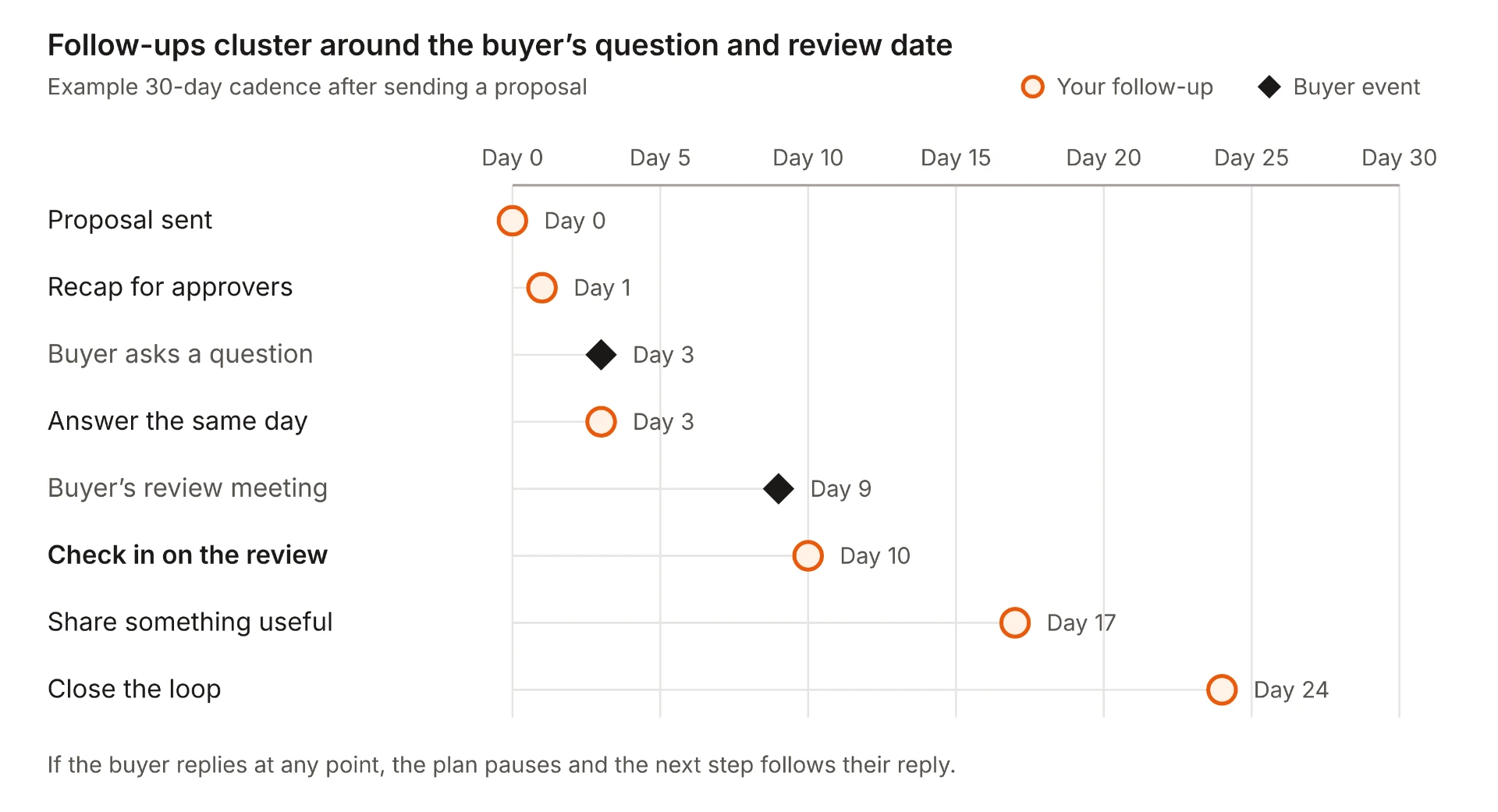
Look at the gaps. Three touches land in the first three days, because the buyer is active and asked a question. Then there is a week of nothing, because that's when they said they would review it.
Day 0
Proposal sent.
End with one line on what happens next: "I'll check in after your review on the 9th."
Day 1
A recap for approvers.
A one-page summary the buyer can forward to finance or their manager.
Day 3
Answer their question the same day.
The answer is the follow-up. Don't add a reminder on top.
Day 10
Check in on the review.
"How did the review go? Did finance have any questions on the payment terms?"
Day 17
Share something useful.
A revised timeline, a short case from a similar project, or an offer of a 15-minute call.
Day 24
Close the loop.
"I haven't heard back, so I'll pause my follow-ups for now. Just reply if the timing changes."
Sales Cadence Automation: What Your AI Sales Assistant Does, And What Stays With You
Automate the remembering, the timing checks and the first draft. Keep the decision to send, and anything about price or the relationship, with a person.
| Task | Who should do it | Why |
|---|---|---|
| Tracking which leads are due, and why | Automation | It's a memory job, and memory is what slips |
| Reading email, WhatsApp and CRM history | Automation | Rebuilding context by hand is the slowest part |
| Writing the first draft | Automation | A draft from real context beats a blank page |
| Pausing when the buyer replies or opts out | Automation | It has to happen every time, on every channel |
| Logging the send to the CRM | Automation | Busy days are when records get skipped |
| Deciding what actually gets sent | You | Your name is on the email |
| Prices, discounts and delivery promises | You | Commitments need a person behind them |
| Negotiation, relationships and closing | You | This is the job automation should free you for |
How An AI Sales Assistant's Follow-Up Loop Works
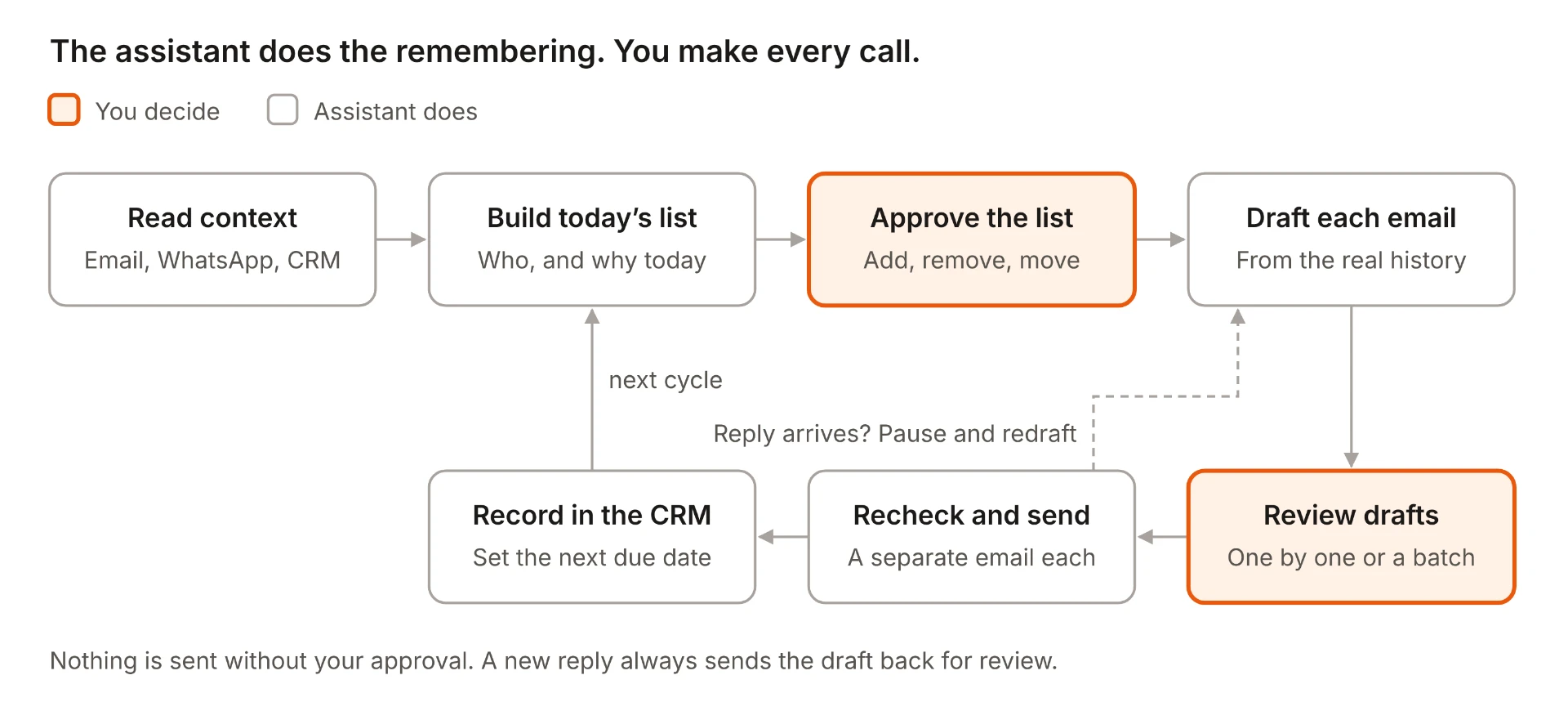
The assistant handles the five memory steps; you approve the list and the drafts. It's sales workflow automation with a person at every decision point. Automated follow-up emails only work if the loop can stop itself, so the reply check just before sending is the most important step in the whole cadence.
This is how Mimasa's lead follow-up automation works. On the rhythm you choose, it sends you today's list in Gosthi, drafts each email with full context, and waits for your approval. Your CRM stays the record.
We Run Our Own Sales This Way
We use the same agents in our own business. Here is what our founder shared about Mimasa AI's own sales, in November 2026:
90%
of our lead generation is automated
41
leads generated in 45 days by agents and workflows
50+
prospect conversations managed by agents and workflows
31.9%
of our tracked follow-up sales messages are managed by AI agents and workflows
And we haven't hired a sales manager yet.
Humans review at checkpoints, guide the agents and own every decision, relationship and closure. Agents do the repetitive work in between.
How To Choose An AI Sales Assistant For Follow-Ups
Choose an AI sales assistant by testing it on your own leads, not on a demo script. Ask it to show you these seven things:
- 1Today's list, with a reason for each lead, not just a due date from the CRM
- 2The real context behind each draft: email, WhatsApp and CRM notes, with links back to the source
- 3A draft that refers to what the buyer actually said, not a template with their name in it
- 4A gap it flags instead of filling, such as a price or delivery date it can't verify
- 5Your approval before anything is sent, one by one or as a selected batch, with a separate email to each lead
- 6A follow-up that pauses when the buyer replies on another channel
- 7The send recorded in your CRM, with failed sends shown rather than hidden
If a tool can't do the sixth one, it isn't following the buyer. It's following a calendar.
For where an AI sales assistant fits in the wider sales process, from lead capture to orders, see our overview of B2B sales automation.
Signs Your Follow-Up Cadence Is Off
Your cadence is off when the buyer has to correct your timing, or when good leads go quiet and nobody notices.
You're Following Up Too Much If…
- Buyers remind you of a date they already gave
- Your follow-ups have nothing new in them
- A reminder goes out after they've replied on WhatsApp
- You get "please stop" replies
- Every lead gets the same rhythm
You're Following Up Too Little If…
- Hot enquiries wait a day for a first reply
- You learn a deal went cold only in the monthly review
- Promised quotes or specs go out late
- Reps can't say what their top leads last told them
- Leads are lost between cold outreach and sales
A Quick Test For Your Team This Week
Pick five open deals and ask each owner what the buyer last said and when they asked to hear back. If the answers take more than a minute, your cadence depends on memory, and memory is the first thing to go on a busy week.
The Short Version
The best sales follow-up cadence is the one the buyer has already given you. Listen for the date, the question and the promise, and time every follow-up to those.
Use your default rhythm only when the buyer hasn't set one, and stop the moment they reply. Let the assistant remember, so your team can sell.