
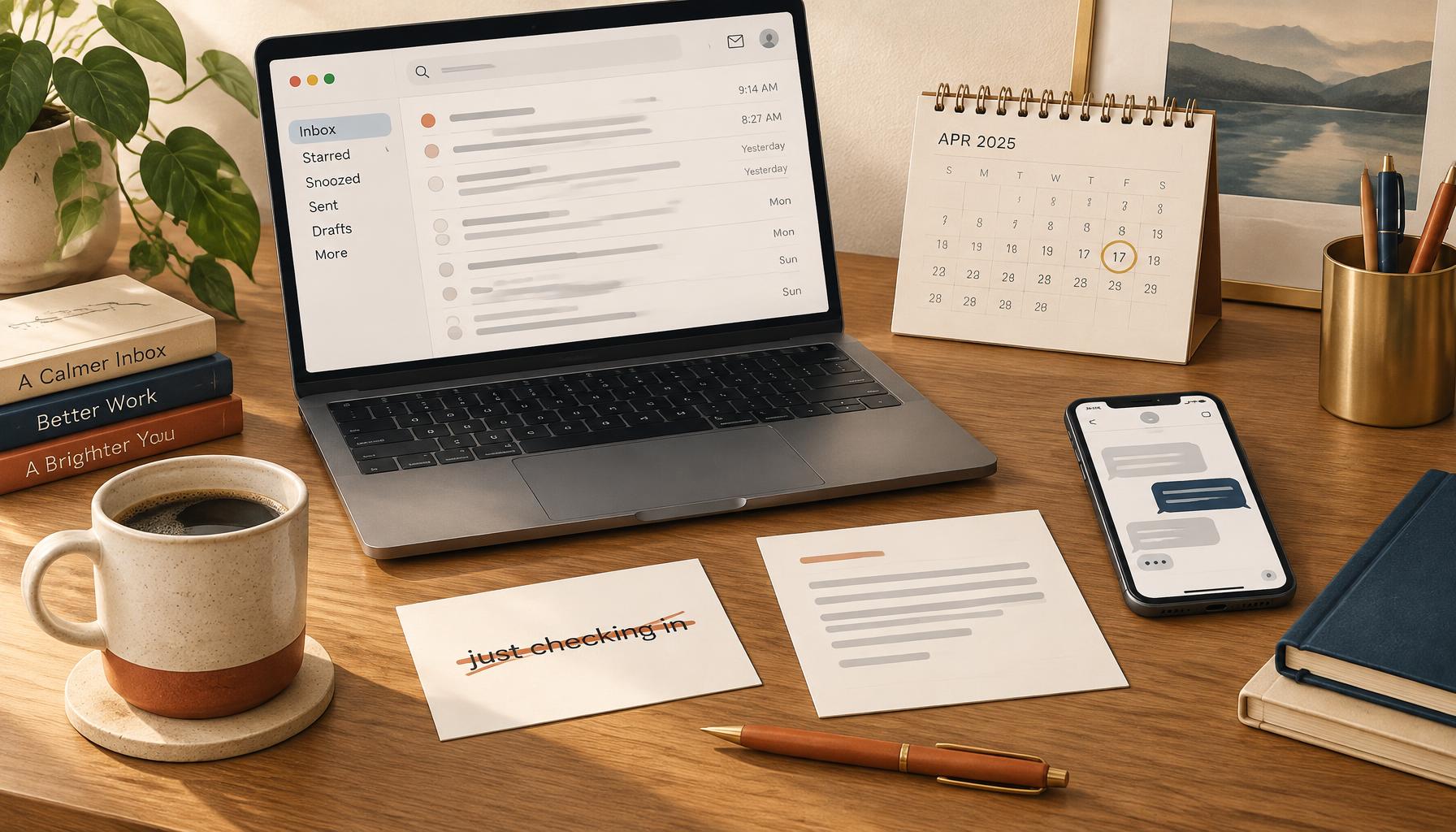
I have written "just checking in" more times than I can count. It almost never got a reply.
For a long time I thought the problem was the wording. I tried "circling back", "bumping this up" and "any update?". None of it worked any better.
What finally worked was not a better template. It was remembering what the buyer had actually said, and putting that in the email.
This guide covers how to write a follow-up email after no response in B2B sales, for both kinds of follow-up: cold emails to people you haven't spoken to yet, and leads you already have after a proposal, a demo or a trade fair.
We'll start with why follow-up eats so much of a salesperson's week. Then you'll get a simple structure, a quick check to run before you hit send, seven real sales situations and three cold email examples, and a look at how an AI assistant can take the remembering off your plate.
Cold Email Follow-Up Vs Sales Follow-Up: Two Different Jobs
"Follow-up" means two different things in sales, and mixing them up is where a lot of bad emails come from.
Cold Email Follow-Up
Generates the lead.
You emailed someone who has never spoken to you, and they haven't replied. The follow-up's only job is to earn a first reply.
Sales Follow-Up
Moves the lead you have.
You've spoken, sent a proposal or met at an event. The follow-up's job is to move the deal to the next step.
| Cold Email Follow-Up | Sales Follow-Up | |
|---|---|---|
| Goal | Get a first reply | Move an active deal forward |
| Who you're writing to | Someone who doesn't know you yet | Someone you've already spoken to |
| Context you have | Your research and your first email | Every email, WhatsApp message, call and promise so far |
| What makes it work | A new reason to reply in each message | Remembering exactly what the buyer said |
| When to stop | After a short sequence, or on any unsubscribe | When they decide, or ask you to stop |
| What a reply means | A new lead for your CRM | The deal moves to quote, order or close |
The two connect. A cold follow-up that gets a reply creates a lead. From that moment it needs sales follow-up instead: the person has told you something, and every message after that should prove you remembered it.
This guide covers both. Most of it is about sales follow-up, because that's where the most time goes and where deals quietly die.
Why Does "Just Checking In" Get Ignored?
"Just checking in" gets ignored because it asks the buyer to do your remembering for you.
Think about what happens when it lands. The buyer has to stop, search their inbox, find your last email, and work out what you were talking about. Then they have to decide what to say. That is a lot of effort for a message that gives them nothing back.
So they leave it for later. Later rarely comes.
There is a second problem. A vague follow-up tells the buyer that nobody on your side is keeping track. If you can't remember what they asked for, why would they trust you with the order?
A good sales follow-up email does the opposite. It shows you were listening, it saves them time, and it makes replying easy.
Why Is Sales Follow-Up So Time-Consuming?
Follow-up is slow because every message starts with digging. Before you can write two lines, you have to rebuild what that buyer said, what you promised and when they asked you to come back.
Here's what a normal Monday looks like for most of us. You open the CRM and there are 40 leads due this week. For each one, you:
- 1Open the CRM record to check the stage and the last note
- 2Search your inbox for the proposal and their last reply
- 3Scroll back through WhatsApp for the questions they asked there
- 4Check your notebook or call notes for anything promised on the phone
- 5Work out if it's even the right day, or if they asked you to wait
- 6Finally, write the email
3+ hours
to rebuild context for 40 follow-ups at five minutes each, before writing a single line.
Illustrative calculation
28%
of a rep's week is spent actually selling. In India, it was 27%.
Salesforce, State of Sales
That's the easy week. Hunting for context before a follow-up is a big part of the rest. Here's where that context usually lives:
Email inbox
The proposal you sent and their last reply
Quick questions, voice notes, "will confirm by Friday"
CRM
Stage, owner and the next follow-up date
Call notes or notebook
Promises made on the phone
A colleague
Whether someone else already replied
When this gets too heavy, three things happen. Follow-ups slip by days. The ones that do go out turn generic, because there was no time to look anything up. And some go out on the wrong day, after the buyer has already answered somewhere else.
None of this shows up in a report. The lead doesn't say no. It just goes quiet, and nobody can say exactly when it was lost.
What Should A Follow-Up Email Include?
Every follow-up email should include three parts: context, value and one ask.
Context
What was last said
Refer to something specific from your last conversation. "You mentioned the board meets on the 14th." One line is enough.
Value
Something useful
Answer an open question, share the document they asked for, or give a short update. If you have nothing new, you are probably following up too early.
One Ask
The next step
Ask one question that is easy to answer. "Would Thursday or Friday work for a 15-minute call?" beats "Let me know your thoughts."
Keep it short. If the buyer has to scroll on their phone, it is too long. Aim for under 100 words.
"Just checking in on my last email."
"You said you'd review the proposal after Thursday's meeting."
"Any update?"
"I've attached the revised specs you asked for."
"Let me know your thoughts."
"Would a 15-minute call on Friday help?"
Before You Hit Send: The 30-Second Context Check
Before any follow-up, take 30 seconds to check four things. This one habit fixed more of my follow-ups than any template.
What did they last say?
Read their last message, not just yours.
Did they reply somewhere else?
Check WhatsApp, a missed call, or a colleague's inbox. The buyer may have already answered.
What did you promise?
If you owe them a quote, a sample or a spec sheet, send that first. A reminder from you when you are the one who is late looks bad.
When did they ask you to come back?
If they said "after the 14th", don't email on the 10th.
The second point matters more than people think. I once sent a "just checking in" email to a buyer who had answered my question on WhatsApp two days earlier. He never replied to the email. I wouldn't have either.
7 Sales Follow-Up Email Examples For Real Situations
The right follow-up depends on where the conversation stopped. Here are seven situations every B2B salesperson meets, with an example for each. Names and companies are illustrative.
1.After Sending A Proposal Or Quote
The buyer has your numbers. Silence usually means they are comparing, waiting on someone, or stuck on one detail.
Hi Ravi,
I sent the proposal for the pump line upgrade last Tuesday. Most teams have a question on the installation timeline at this stage, so I've added a one-page schedule.
Is there anything in the proposal you'd like me to walk your team through?
Best, Neha
2.After A Demo Or Site Visit
The buyer saw the product. Follow up on what they reacted to, not on the demo in general.
Hi Meera,
At Thursday's demo you asked whether batch tracking works across both plants. It does. Here's a two-minute clip showing exactly that.
Would it help to run the same demo for your plant head next week?
3.After A Trade Fair Or Event Meeting
You met dozens of people. So did they. Lead with the moment you shared.
Hi Arjun,
We spoke at the packaging expo about the delays in your carton supply. You mentioned the busy season starts in December.
I've put together lead times for December orders. Shall I send them over, or would a short call be easier?
4.When The Buyer Said "Let Me Discuss Internally"
They gave you a reason to wait. Respect the timing, then make the internal discussion easier.
Hi Priya,
You said you'd review the proposal with your team after Thursday's meeting. Did the delivery timeline work for them?
If it helps, I can send a short summary your team can forward to finance.
5.When Your Team Owes Them Information
Sometimes the silence is on your side. If you promised something, the follow-up is the delivery, not a reminder.
Hi Rohan,
As promised, here's the revised quote for the Pune route with the weekend pickup option included.
The rate holds until the end of the month. Want me to block the slots for your first shipment?
6.When The WhatsApp Chat Went Quiet
Many B2B conversations in India move between WhatsApp and email. If the chat stopped, pick it up where it stopped, on the same channel if you can.
Hi Anita, you'd asked for the sample batch report on WhatsApp last week. Sharing it here. Shall I arrange the trial order once your QC team has had a look?
Keep WhatsApp follow-ups even shorter than email: two or three lines, one question.
7.The Last Follow-Up Before You Pause
After a few unanswered follow-ups, send one clear, polite message that leaves the door open. It often gets a reply, because it is easy to answer.
Hi Vikram,
I haven't heard back on the conveyor proposal, so I'm guessing the timing isn't right. I'll pause my follow-ups for now.
If things change, just reply to this email and I'll pick it up from where we left off.
This is not a guilt trip. It gives the buyer a simple way to say "not now" or "yes, still interested", and both answers help you.
Cold Email Follow-Up Examples (Before They're A Lead)
A cold email follow-up after no response can't refer to a past conversation, because there wasn't one. Each follow-up has to bring a new reason to reply instead.
- 1
Cold Follow-Up 1: A New Angle, A Few Days Later
EmailSubject: Re: Carton supply for the festive seasonHi Kavya,
One more thought on my last note. The festive season is usually when carton lead times stretch the most.
If that's on your planning list too, would a 10-minute call next week be useful?
- 2
Cold Follow-Up 2: Something Useful, A Week Later
EmailSubject: Lead-time checklist for December ordersHi Kavya,
Sharing a one-page checklist we put together for planning December packaging orders. No reply needed if it isn't relevant.
If it is, I'm happy to walk your team through it.
- 3
Cold Follow-Up 3: Closing The Loop
EmailSubject: Closing the loopHi Kavya,
I don't want to fill your inbox, so this is my last note on this. If carton supply becomes a priority later, just reply and I'll pick it up from here.
Rules For Cold Follow-Ups
- Make each follow-up shorter than the first email.
- Never just "bump" the first email. Add a new angle or something useful.
- Keep the sequence short. Three or four touches is common; agree a limit as a team.
- Honour "not interested" and unsubscribe requests straight away, and follow the email rules of each country you send to.
- The moment someone replies, stop the sequence. They're a lead now, and sales follow-up takes over.
Follow-Up Email Subject Lines That Get Opened
The best follow-up subject lines name something real from the conversation. A buyer scanning their inbox should know what the email is about in two seconds.
- Your proposal for the pump line upgrade
- The batch tracking you asked about
- From our chat at the packaging expo
- After your internal review
- Revised freight quote for the Pune route
- Should I close this for now?
Avoid
- "Quick question"
- "Following up"
- "Touching base"
They hide the topic and look like every other sales email in the inbox.
How Long Should You Wait Before Following Up?
Wait for the date the buyer gave you. If they gave none, use a steady rhythm your team agrees on for that stage, for example every three working days on an active proposal.
A few rules I follow:
Their timeline beats yours.
"After the board meeting" means after the board meeting.
Answer before you remind.
If they asked a question, the next email is the answer.
Stop when they reply.
A reply on WhatsApp or a call counts. Don't let a scheduled email go out after they've answered.
Stop when they ask you to.
Record it, and don't contact them again unless they come back.
There is no magic number of follow-ups. What matters is that every one of them adds something.
Can AI Write Your Follow-Up Emails?
Yes, an AI follow-up email can save hours, but only if the AI reads the real conversation first. A draft written from a template will sound like every other "just checking in" email.
Remember where the time actually goes. Typing the email is the quick part. Rebuilding the context for 40 leads across email, WhatsApp and the CRM is the slow part. Good follow-up email automation takes over that slow part and leaves the judgement with you.
How An AI Follow-Up Assistant Works, Step By Step
- 1
You set the rhythm.
Every three days, once a week, or a different rhythm for each stage. Dates the buyer gave you always come first.
- 2
It builds today's list.
It checks every lead and tells you who needs a follow-up today, and why: "review date has arrived", "you owe a revised quote", "no reply in six days".
- 3
You approve the list.
Take out anyone you'd rather call yourself, or move a lead to another day.
- 4
It drafts each email with full context.
It reads the latest email thread, WhatsApp messages and CRM notes for each lead, then writes a short email built on what the buyer actually said. If something is missing, it flags it instead of making it up.
- 5
You review and send.
Edit and approve one draft at a time, or approve a batch in one go. Each lead still gets their own separate email.
- 6
It checks again before sending.
If the buyer replied in the meantime, on any connected channel, that draft pauses and the context refreshes.
- 7
It records the result.
The send is logged against the lead in your CRM, and the next follow-up date is set.
Gold-edged steps are where a person decides.
In Mimasa, all of this runs inside Gosthi, in the sales bridge and each lead's thread your team already works in. Your CRM stays the system of record.
What Changes In Your Week
| Task | Doing It Yourself | With A Follow-Up Assistant |
|---|---|---|
| Deciding who to follow up | Scanning CRM reminders and your memory | Today's list arrives, with a reason for each lead |
| Finding the context | Inbox, WhatsApp, CRM and notebook, one by one | A summary beside each draft, with links to the source |
| Writing the email | From scratch, or "just checking in" | A draft built on the last real conversation |
| Sending to 20 leads | 20 separate emails, one at a time | Review, then approve a batch; each still goes separately |
| Buyer replies on WhatsApp | Easy to miss; the email goes anyway | The queued follow-up pauses |
| Updating the CRM | Often skipped on a busy day | Recorded after every send |
This is how we built Mimasa's lead follow-up automation. It isn't another tool to manage. It's an assistant that does the remembering, so your team can spend its time on strategy instead of chasing.
The Short Version
A follow-up email after no response works when it proves you were listening. Check what the buyer last said, add something useful, and ask one easy question.
Your buyer already gave you the context. The follow-up is your chance to show you remembered it.
Stop Remembering Every Lead Yourself
Mimasa's Lead Follow-Up agent sends you today's list and drafts each email with full context, ready for your approval.
Book A Demo