
Agentic Automation vs Agentic Workflow Automation: Is There Really a Difference?
Agentic automation and agentic workflow automation are related, but they solve different operational problems. Learn when to use autonomous AI agents, structured intelligent workflows or both together.
By Tarun Tyagi, Founder and CEO, Mimasa AI · September 3, 2026 · 6 min read
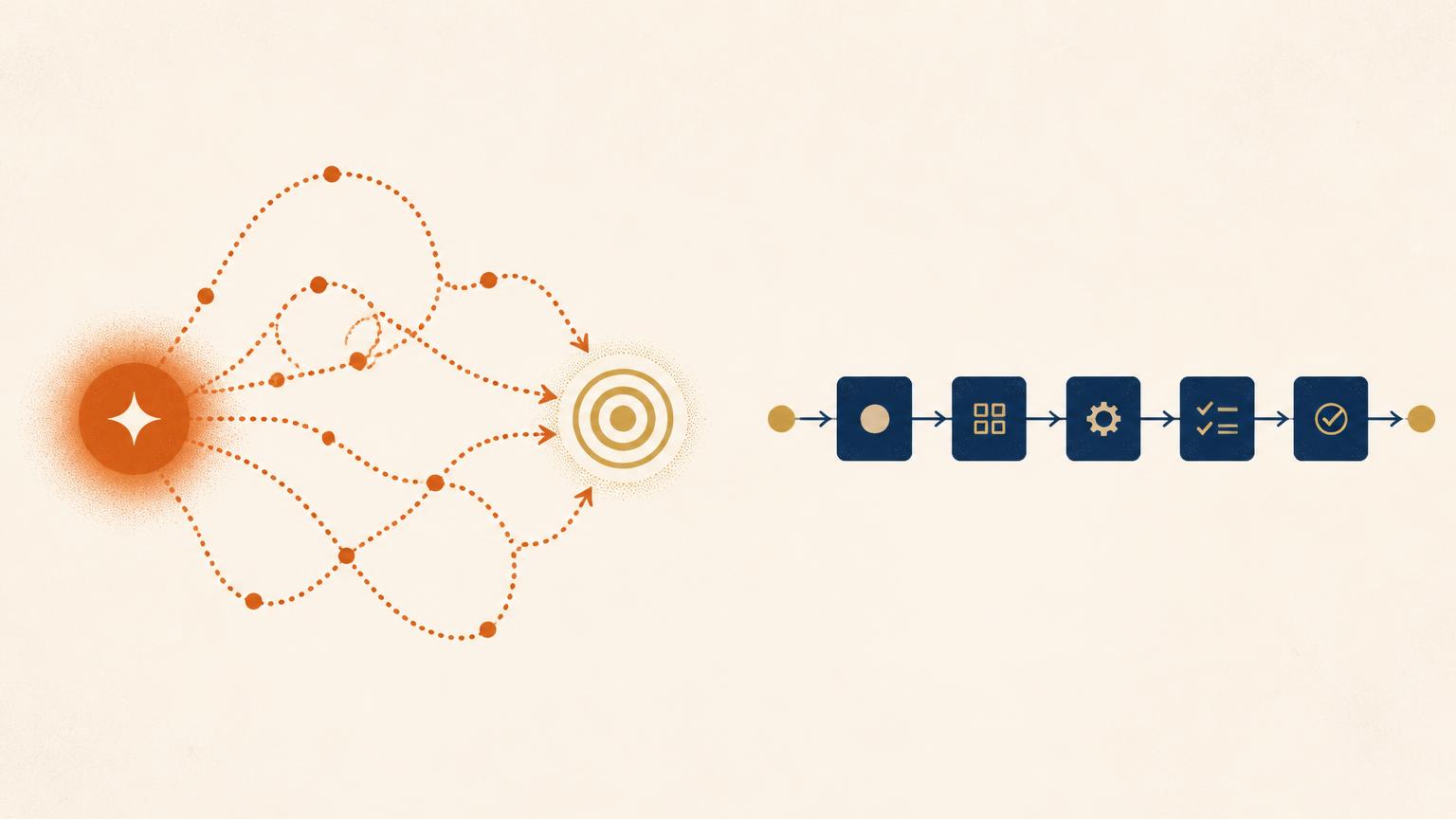
In practice, the terms agentic automation and agentic AI workflow automation are often used interchangeably. They are closely related, but they do not describe exactly the same way of getting work done.
The simplest distinction is this: agentic automation gives an AI agent a goal and allows it to determine how to complete the task. Agentic workflow automation gives AI intelligence a defined process within which to operate. One begins with an outcome and allows the path to emerge. The other begins with an orchestrated path and makes selected stages intelligent.
What Is Agentic Automation?
Among AI automation tools, agentic systems can understand an objective, evaluate context, choose tools, act and adjust their next step based on results.
Consider an email agent responsible for handling sales enquiries. It may read a message, identify the company, search the CRM, enrich the account, assess whether the lead matches qualification criteria, update the opportunity and prepare a personalised response.
If the account already exists, it may update the record. If information is missing, it may use another tool. If the enquiry is not relevant, it may classify and archive it. The agent works toward the assigned outcome rather than following one identical route every time.
This principle applies to a customer service agent, chatbot agent or WhatsApp agent. Each receives a task, reasons about what’s needed and uses permitted applications, APIs, skills or MCP tools to finish it. This is goal-driven automation. You can see how this is configured in the Mimasa AI Agent Builder.
What Is Agentic Workflow Automation?
Automated workflow software begins with a defined trigger, such as a file upload, form submission, scheduled time, email, database change or API request. It then moves through connected stages: retrieve data, transform information, apply AI, evaluate conditions, request approval and execute actions.
For example, an invoice process may begin when a document reaches a shared inbox. The automation workflow extracts fields, checks the supplier, validates amounts, compares the purchase order and routes exceptions to a reviewer. Approved invoices continue automatically. Teams automate workflow processes without losing financial controls.
AI helps interpret the document and identify inconsistencies, but the workflow automation platform still defines the overall process, controls and possible paths.
The Core Difference: Goal Versus Process
With agentic automation, the builder defines the agent’s role, objective, instructions, knowledge, skills, memory, tools and permissions. The agent decides what action to take next.
With agentic workflow automation, the builder defines the trigger, stages, branches, conditions, approvals and actions. AI provides intelligence at specific points, but the automation follows an intentionally designed operating structure.
Where the Two Approaches Overlap
The boundary is not rigid. Modern AI workflow automation tools and automated workflow tools can place an autonomous agent inside a structured process. Likewise, an AI agent can initiate one when a task must follow an approved path.
A customer service workflow, for example, may classify an incoming request and then call a customer service agent to investigate and resolve it. If the requested resolution involves a refund, the agent may start a separate approval workflow that follows financial controls.
Both approaches may use the same LLMs, integrations, APIs, data sources and MCP tools. Both act across CRM, ERP, accounting and communication systems. The difference lies in how intelligence and workflow automations are organised.
When Should You Use an AI Agent?
Choose agentic automation when:
- The task has a clear goal, but the sequence cannot be fully predicted.
- Inputs vary significantly and require contextual interpretation.
- The system must select among multiple tools while working.
- The agent needs to investigate, converse, research or respond dynamically.
- The task can be completed autonomously within defined permissions.
When Should You Use a Workflow Builder?
Choose among automation workflow tools when:
- The process has a recognisable beginning, stages and completion point.
- Business rules determine how cases should be routed.
- Actions must occur in a particular order.
- Human approvals or formal controls are required.
- Teams need consistent execution across departments and systems.
- Failures and exceptions must be traced to a specific process stage.
Finance processing, onboarding, document approvals, compliance checks, reporting and production alerts are typical enterprise workflow automation candidates. These automated workflows benefit from consistent execution.
A no code workflow automation platform helps business teams configure automated workflow systems while technical teams govern access, integrations and deployment.
Why Enterprises Usually Need Both
Agents bring adaptability. They interpret ambiguous requests, select capabilities and respond to new information. Workflow automation AI brings coordination by connecting systems, enforcing sequences, managing approvals and making processes observable.
An enterprise may use an email agent for supplier communication, then use enterprise workflow automation software to validate documents, obtain approvals and update financial systems. A sales agent may research accounts, while automated workflow solutions manage qualification, assignment and CRM notifications.
Combining both creates a practical model for enterprise agentic automation: agents handle work that requires flexible intelligence, while workflows provide reliable operational rails. Our field notes on revolutionizing workflows with Mimasa AI walk through how that pairing behaves in live deployments.
Choosing the Right Automation Approach
Before comparing workflow automation platforms and workflow automation solutions, ask five questions:
- Is the outcome clear?
- Is the sequence predictable?
- Which decisions require contextual reasoning?
- Which actions require approval or strict control?
- What evidence will be needed after execution?
If the outcome is clear but the route varies, start with an agent. If the process follows known stages, use AI for workflow automation. If it contains predictable and ambiguous work, combine them.
The Bottom Line
Agentic automation is goal-driven: an AI agent decides how to complete an authorised task. Agentic workflow automation is process-driven: a workflow defines how data, decisions, approvals and actions move from trigger to outcome, with AI making selected stages more intelligent.
Neither approach is universally better. The right choice depends on whether the work needs autonomy, orchestration or both. Used together, they allow businesses to automate workflows without forcing every situation into rigid rules and deploy AI agents without giving up enterprise control.
Decide Between An Agent And A Workflow
Bring one process. We will map which stages need an autonomous agent, which need an orchestrated workflow and where the two should meet.