
Top 5 Reasons Great Ideas Die Between Chat, Tasks, And Meetings
And what it is costing your team, one handoff at a time.
By Team Mimasa AI · August 13, 2026 · 7 min read
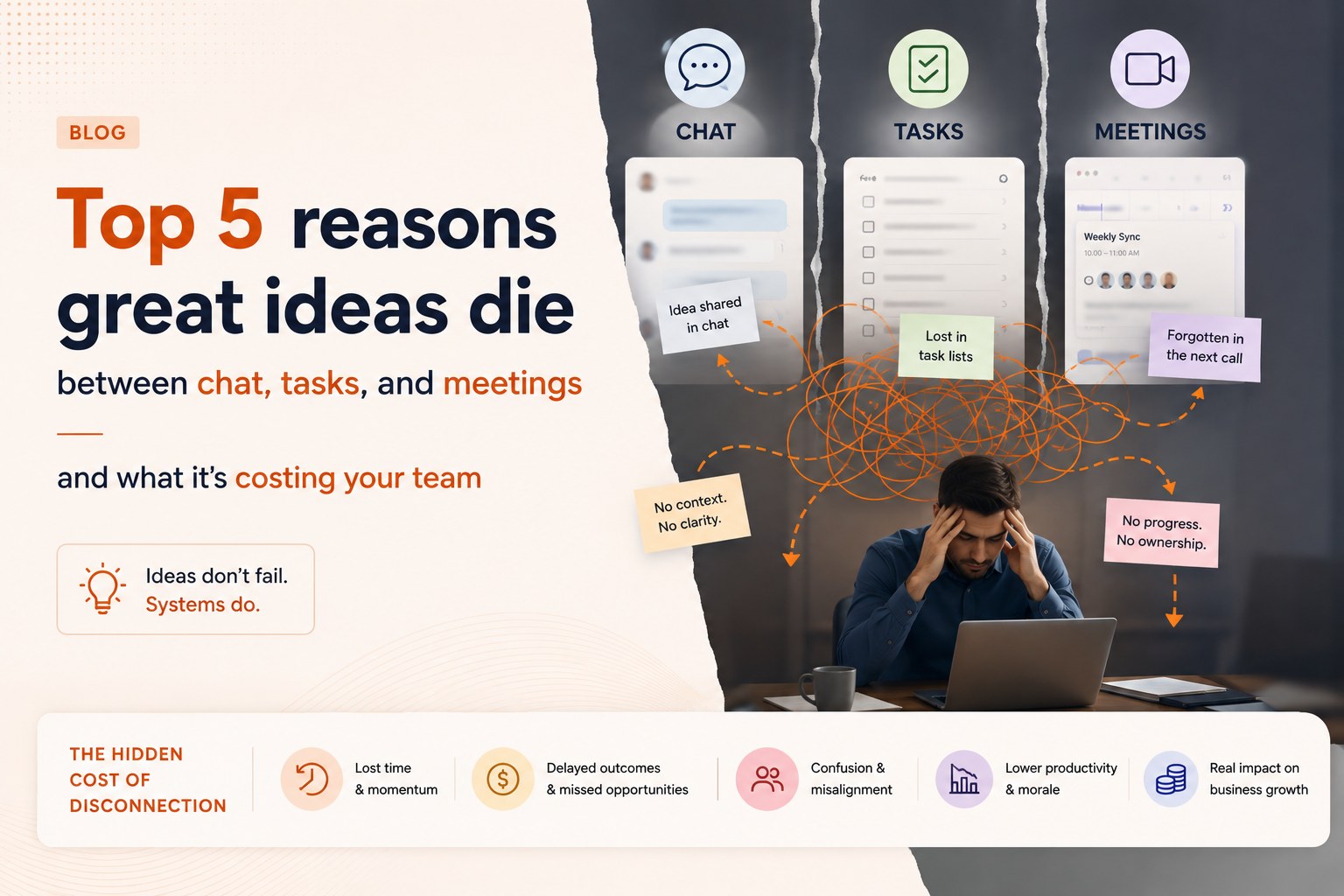
Every growing organisation is quietly running the same experiment, and most leaders do not realise it is happening.
An insight gets flagged in one tool. The conversation about it happens in a second. The task gets tracked in a third. The follow-up meeting happens in a fourth. And if anyone remembers there is an AI agent that could have handled the repetitive part of it — that lives in a fifth.
Nothing is technically broken. Every tool works exactly as designed. But the idea itself rarely survives the trip between them.
This is what tool sprawl actually costs a business: not a missing feature, but a slow, invisible leak of decisions, ownership, and momentum.
The Hidden Cost Of Context Switching
Before breaking down where ideas actually get lost, it is worth grounding this in something more concrete than anecdote.
A Harvard Business Review analysis of 122,000 real application-switching events found that knowledge workers now toggle between apps and tabs nearly 1,200 times a day. Microsoft's Work Trend Index estimates the resulting cost of reorientation at roughly four hours per week, per employee — nearly a full working day, every single week, spent simply trying to remember where a task, decision, or conversation was left off.
"It is not the two seconds it takes to click between tabs. It is the mental effort required to rebuild the context you just left behind."
For teams managing remote and hybrid collaboration, distributed workflow automation, and a growing list of external stakeholders, this is not a minor inefficiency. It is a structural tax on productivity — and it compounds daily.
Where Ideas Actually Get Lost
Reason 1: The Decision Dies In Chat
Team collaboration tools are excellent at hosting conversation and terrible at preserving outcomes. Someone proposes an idea, a few colleagues react, someone says "let us move on this" — then the thread scrolls away and takes the decision with it. No owner, no timestamp, no record it was ever made. Weeks later the same idea resurfaces in a different channel, and nobody notices it is the second time.
Reason 2: The Task Never Gets Created
Even when a decision holds, converting "someone should do this" into an owned, trackable task in your project management software is a manual step — copy, switch tools, paste, assign. Manual handoffs are precisely what gets skipped under deadline pressure, which is exactly when they matter most.
Reason 3: The Meeting Has No Memory
Meetings remain one of the least connected parts of the modern digital workplace. Real alignment happens on the call, then it ends, and the outcome lives only in whoever happened to be paying closest attention. Without a direct link back to the conversation or task that triggered it, a meeting becomes an isolated event rather than a connected part of the workflow.
Reason 4: The AI Agent Gets Forgotten
Most organisations have already invested in some form of AI-powered automation or agentic AI tooling. The problem is not capability, it is adoption. When automation lives in a separate console with its own login, it gets forgotten in the moment it is needed most, and a person ends up completing the task manually. Again.
Reason 5: External Collaboration Becomes A Trade-Off
Every organisation eventually needs to bring a vendor, client, or agency partner into a live project without exposing the rest of the company. Most teams solve this poorly: full internal chat access and a hope that nobody scrolls too far, or an email-based relationship that moves at the pace of 2012. Neither reflects modern external collaboration security standards.
It Is Not The Tools, It Is The Seams
None of these five failure points are really about any individual tool being bad. Your chat platform is fine. Your task tracker is fine. Your video conferencing tool is fine.
The failure lives in the seams between systems — every handoff where a decision, task, or piece of context has to be manually carried from one platform into another. The more tools an organisation stitches together, the more seams exist for good work to quietly fall through.
Ask your team this question directly: the last good idea that disappeared without a trace — which of these five reasons actually killed it? Most people can answer in seconds. That instant recognition is not a coincidence.
From Tool Sprawl To A Unified Collaboration Layer
The fix was never "add a sixth tool." A sixth tool just introduces a sixth seam. This is the exact gap Gosthi was built to close — the collaboration layer built directly into Mimasa AI, where conversation, execution, meetings, and AI work inside one shared workspace.
Decisions Become Tasks In Place
A decision made in a Bridge becomes an owned task without leaving the thread — no copy, no switch, no paste.
Meetings Stay Connected
A meeting started from a thread is rejoinable from that same thread later, instead of being buried behind a calendar link.
AI Sits In The Room
An AI agent is not hiding in a separate console. It is addressable by @mention, like a teammate, doing the part of the work that used to fall through the cracks.
Scoped External Access
A client or vendor is granted access to exactly the one room they need — nothing more — replacing the all-or-nothing trade-off most teams still live with.
The goal was never a better version of any single tool. It is fewer places for a good idea to get lost on its way to becoming real work.