
What Is L1 In Procurement?
India's Department of Expenditure defines it in its Manual for Procurement of Goods (2024) as "the lowest acceptable bid that is techno-commercially responsive."
Now the part most guides skip. Your system, your ERP or your spreadsheet can sort quotes by price in a second. It will happily name an L1. But it will not tell you why that supplier is L1, whether the quote is safe to accept, or what it will really cost you.
L1 is a number. What is missing is the intelligence behind it.
L1, L2 And L3 In One Minute
L1
Lowest acceptable price
First in line for the order
L2
Second lowest
Next in line if L1 fails a check or backs out
L3
Third lowest
A fallback, and a useful price check
You may also see L-1. It means the same thing.
What if two suppliers tie for the lowest price? It depends on the rules. On the Government e-Marketplace (GeM), the portal picks one tied L-1 bidder at random, as a Railway Board letter of 21 December 2023 points out. A coin toss decides the winner. The ranking says nothing about quality.
How L1 Is Decided: Quotation Comparison, Step By Step
| Step | What Happens | What Is Usually Missing |
|---|---|---|
| 1. Request quotes | An RFQ or tender goes to suppliers | Context on what was bought before, and at what price |
| 2. Collect quotes | PDFs, sheets, emails and chats arrive | One common format |
| 3. Check eligibility | Someone checks documents and specifications, often partly and by eye | A full, consistent check |
| 4. Compare | Quotes go into a comparison sheet | The same scope and basis for every quote |
| 5. Rank | Lowest price becomes L1 | The reasons behind the ranking |
| 6. Approve | A manager signs off | A clear record of why |
In larger public tenders this follows a two-bid system. As Baker McKenzie's guide to Indian public procurement explains, technical bids are opened first. Only the technically acceptable offers then have their financial bids opened and ranked.
Step 4 is called quotation comparison. It is where most of the mistakes happen. One supplier quotes per unit. Another quotes per box. One includes delivery. Another does not. If the quotes are not on the same basis, the ranking is not fair.
For tenders on GeM, GeM bid processing automation shows how bid requirements and eligibility can be extracted and prepared for human review.
Six Things An L1 Ranking Never Tells You
The lowest quote shows the price of the product. It does not show the cost of buying it, owning it or defending the decision. These six gaps explain why the lowest quote is not always the best choice.
Is This Price Fair?
A ranking compares quotes only with each other. It does not compare them with what you paid last time, or with what the market charges. If all three quotes are high, the lowest one is still high.
A smarter check: How does each price compare with our last purchase, and with the other suppliers on this RFQ?
Are They All Quoting The Same Job?
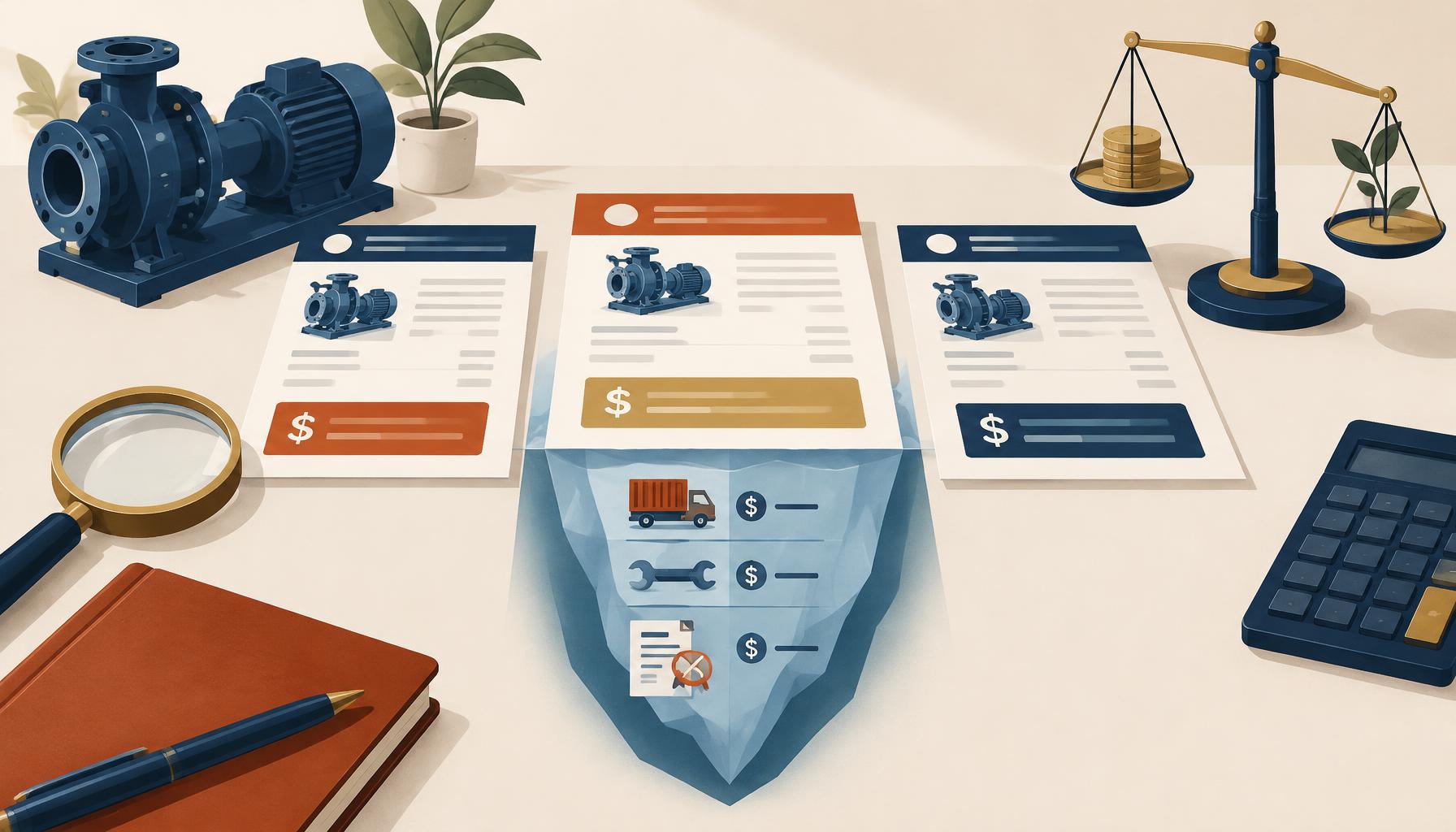
Supplier A quotes the machine. Supplier B quotes the machine, delivery and installation. The cheaper one is cheaper because it promises less. Procurement Express calls this the cost iceberg: the quoted price sits above the water, while delivery, installation, training and maintenance sit below it.
A smarter check: Line up every quote against the full scope and show what is included, excluded or simply not mentioned.
Does The Quote Pass Every Check?
Expired certificates. Missing documents. A quote that has already lapsed. A specification that is slightly off. These are easy to miss when five quotes arrive in five formats and the deadline is tomorrow.
A smarter check: Run the same list on every quote, and give a reason for every flag.
What Does It Cost Over Time?
The cheapest purchase can be the most expensive to own. The New Zealand Government Procurement guide says: "Best value for money is the lowest whole-of-life cost." In its example, Supplier A started cheaper ($27,800 against $30,200) but cost $92,800 over five years against $62,700 for Supplier B.
A smarter check: Show both views side by side: price for this order, and cost over the life of the product.
How Risky Is This Supplier?
A very low price can be a warning. India's procurement manual says the price "should not be abnormally low" where it could lead to non-performance. A commentary from the Centre for Business and Commercial Laws at NLIU warns such a contractor "might cut quality, delay completion, claim compensation, or even threaten to default."
A smarter check: Bring in the supplier's delivery history, past disputes and any red flags.
Can You Explain The Decision Later?
Six months on, someone asks: "Why did we not pick L1?" The reasons live in emails, calls and a spreadsheet called Final_v7. Nobody can answer quickly.
A smarter check: Record who decided, what they saw, which rules were applied and why.
One RFQ, Three Different L1s
You need an industrial pump. Three suppliers send quotes. All figures are in ₹ lakh and are made up to show the idea. They are not real quotes.
Illustrative Scenario
| Supplier | Quoted Price | Left Out Of The Quote | Like-For-Like Price | Cost Over 5 Years |
|---|---|---|---|---|
| A | 9.60 | Freight and installation (+0.95) | 10.55 | 16.55 |
| B | 10.40 | Nothing | 10.40 | 12.00 |
| C | 10.10 | Nothing | 10.10 | 13.10 |
On quoted price
Supplier A is L1
₹9.60 lakh
Like for like
Supplier C is L1
₹10.10 lakh
Over 5 years
Supplier B is L1
₹12.00 lakh
Same three quotes. Three different winners. Supplier A falls to third once freight and installation are added. Supplier B wins over five years thanks to a longer warranty and lower yearly service costs.
Two more things hide behind the numbers. Supplier C's motor rating is below your specification, so a person must decide whether that is acceptable. Supplier A's quality certificate has expired, so it may fail your compliance check outright.
A price-sorted list shows none of this. It would simply say: "Supplier A is L1."
What An Intelligent L1 Looks Like: RFQ Automation Done Right
An intelligent L1 is not a different number. It is the same ranking, with the reasoning attached, so you can act on it. Here is what that looks like for the pump example:
Best fit: Supplier B
Lowest cost over 5 years. All documents valid. Price is 3% below your last purchase.
Needs your decision: Supplier C
Lowest like-for-like price, but the motor rating is below specification. Accept or reject the deviation?
Blocked: Supplier A
Quality certificate expired. Freight and installation are missing from the quote (+₹0.95 lakh).
The price comparison is the easy part. What makes it intelligent is that every flag comes with a reason, and every open question goes to a person.
This is the idea behind Mimasa AI. Its AI agents take on the repetitive work of quotation comparison, and people keep the decisions:
Agents Prepare
- Read quotes in whatever format they arrive: PDF, Excel or email.
- Check each one against your scope, documents and specifications.
- Compare them on the same basis, for this order and for the long term.
- Explain the ranking, and flag what needs a human decision.
- Record who approved what, and why.
People Decide
Accept or reject deviations, approve the award and overrule the ranking when judgement says so. Your ERP or procurement system stays the system of record. The intelligence sits on top of it.
This is what RFQ automation should mean. It is not just a faster sort by price. It is a ranking you can explain, defend and learn from. It is also a good first step into wider procurement automation, because the work is repetitive, rule-based and easy to check.
Where Procurement Automation And AI For Procurement Fit In
Most teams already have some automated procurement software. It raises purchase orders, stores quotes and tracks spend. That is useful. But it mostly records and routes. The judgement is still left to people, one spreadsheet at a time.
This is where AI for procurement earns its place. It is strongest on work that is repetitive, rule-based and easy to check, and comparing quotes is exactly that. If you are looking at procurement automation tools, ask four questions:
- Can it read quotes in any format, or only structured forms?
- Does it check scope, documents and specifications, or only prices?
- Does it explain the ranking in plain words?
- Does it keep a record of who decided what, and why?
A tool that says "Supplier A, score 87" is not enough. AI-powered procurement software should show its reasoning, so a person can agree with it or overrule it.
You may also hear the term agentic AI in procurement. It simply means software agents that carry out steps such as reading a quote or checking a rule, and then hand the decision to a person.
The best way to start is with one process, not ten. Pick the RFQ. Fix it from end to end: send the request, collect the quotes, compare them and record the decision. An automated RFQ flow also gives you clean data for the next round. Once the order is placed, the same approach carries into invoice processing automation, where invoices are matched back to the purchase order.
A 7-Point Quotation Comparison Checklist You Can Use Today
You do not need software to start. Before you award any order, ask:
- 1
Same scope?
List what each quote includes and excludes: delivery, installation, testing, training.
- 2
Same basis?
Convert units, taxes, currency and delivery terms to one format.
- 3
Documents in date?
Certificates, registrations and the quote's own validity.
- 4
Specification met?
Mark every deviation and decide in writing whether you accept it.
- 5
Price fair?
Compare with your last purchase and with the other quotes. Ask about any price far below the rest.
- 6
Supplier record?
On-time delivery, quality, past disputes.
- 7
Cost over time?
Add warranty, service, spares and running costs.
An AI agent for procurement can run this checklist on every quote, every time. That is where the real gain lies: consistency, not speed.