
Ask any buyer what RFQ stands for. Half-joking, they'll say: Really Frustrating Quotes.
They're not wrong. You write a careful request. You send it to six suppliers. Then the replies arrive, and each one seems to answer a slightly different question.
One prices the box.
One prices the box, the cables and two years of support.
One forgot the delivery date.
One sent a photo of a signed letter.
Comparing them isn't maths. It's a translation.
And translation is exactly what AI has become good at. Here's how it works, and what it means for your team.
RFQ Automation, In One Line
RFQ automation is software that sends requests for quotations, reads the replies and compares them, so your team can choose faster and with better reasons.
The First Half: Old News
An automated RFQ that emails ten suppliers at once has been around for years. It's part of most procurement automation already.
The Second Half: New
Reading the replies, understanding them and comparing them fairly used to need a person. Now AI can do the heavy lifting.
Why Manual Quotation Comparison Breaks
Most teams run solid procurement ERP software. The approval flow works. The vendor master is clean.
But a procurement software system thinks in neat rows and columns. Quotes don't. So someone builds the quotation comparison sheet by hand, every single time. That's where things slip:
- Apples vs orangesOne quote is per unit, another per lot.
- Missing piecesFreight, installation or licences quietly left out.
- Expired papersA certificate that lapsed last month.
- Short horizonsThe cheapest price, with the costliest upkeep.
- No paper trailThe "why" lives in someone's head.
<20%
of the data available to procurement teams is used for decisions.
McKinsey, 2026
57%
of procurement chiefs named siloed working as a barrier to value.
Deloitte CPO Survey, 2025
This is the limit of rule-based automated procurement systems. Procurement process automation can move a quote from inbox to folder. It can't tell you what the quote leaves out.
The Four Tests AI For Procurement Runs On Every Quote
Generative AI in procurement can read PDFs, spreadsheets, scans and email text the way a person does. Gartner names this ability, multimodality, as one of three advances reshaping procurement. 72% of procurement leaders are now prioritising generative AI.
But reading is only step one. Good procurement AI puts every quote through four tests, the same four a seasoned buyer runs in their head.
Test 1
Complete Scope
Does the quote cover everything you asked for? Freight, installation, training, spares, licences? AI matches each quote line to your RFQ and flags what's missing.
Test 2
Valid Compliance
Are the certificates valid today? Does the product meet the spec? Is the price valid long enough for your approval cycle? AI checks dates, ratings and terms against your rules.
Test 3
True Cost
The headline price is the start, not the answer. Warranty, service, spares and delivery all change the real bill. Gartner's 2024 research on total cost of ownership warns that buying on unit price alone can push costs up.
Test 4
A Clear Next Step
A ranking isn't a decision. AI recommends the best fit, explains why and suggests the next steps: award, hold or clarify.
Inside Mimasa AI: From Inbox To Approved Award
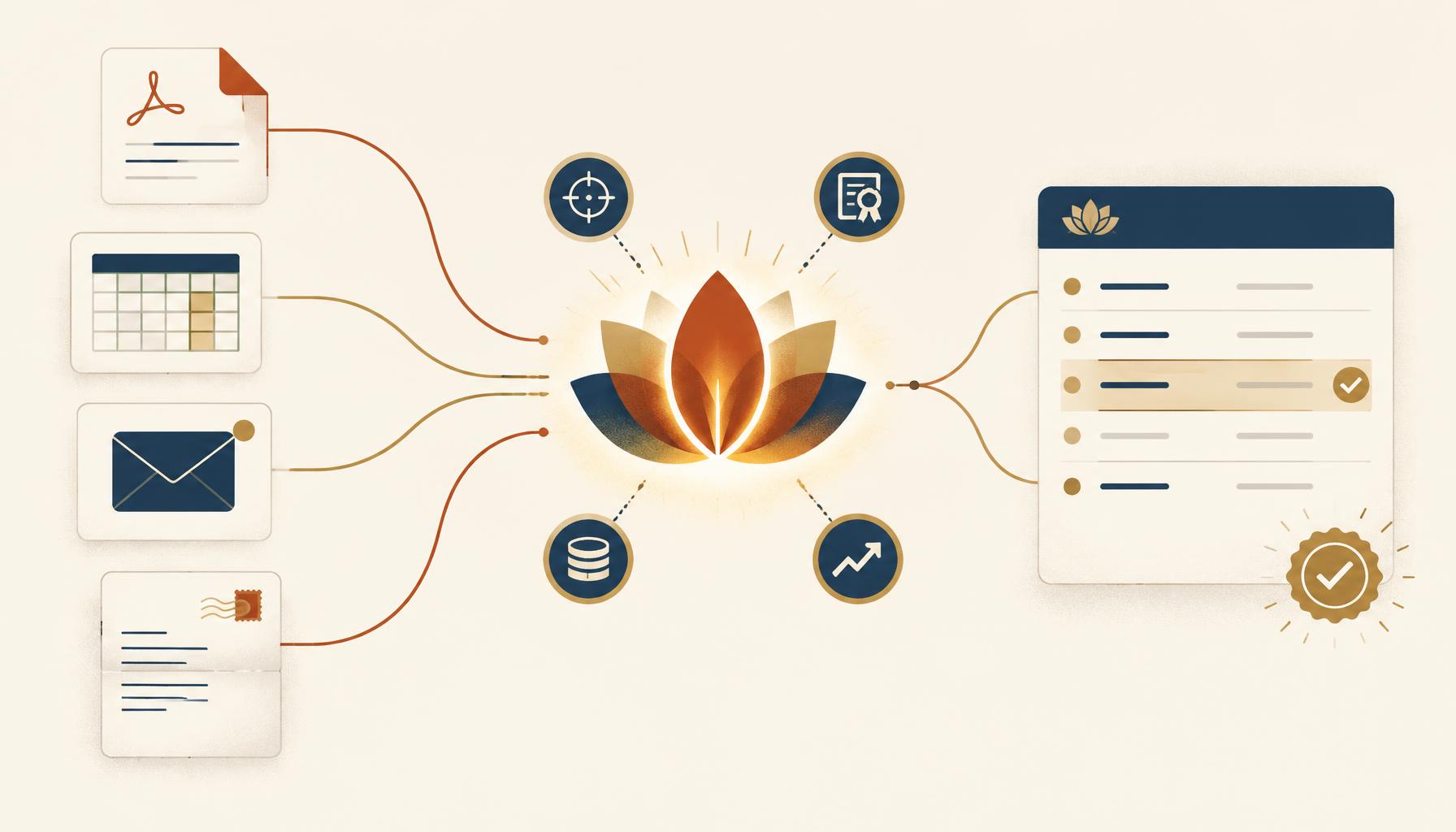
Mimasa doesn't ask you to change how suppliers send quotes, or which ERP you run. It works with what you already have.
Any Format In, One Clear Decision Out
- PDF quote
- Excel sheet
- Email reply
- Scanned letter
Mimasa AI
Reads every quote and runs four tests: scope, compliance, true cost, next step.
Recommendation
Best fit, reasons and next steps
You Approve
In Gosthi, where people decide
Your ERP
PO draft, decision saved with its reason
- 1
Quotes come in from anywhere.
Email, supplier portal, WhatsApp, shared folders. Mimasa picks them up where they land.
- 2
One view, in minutes.
Every quote is read and laid side by side. Units, taxes and freight are aligned automatically.
- 3
Four tests, every time.
Scope, compliance, true cost and next step, each finding linked to its source line. Where your ERP holds a supplier's track record, it sits right beside the quote.
- 4
A recommendation, not just a rank.
The best-fit supplier, the reasons in plain words, and the next steps.
- 5
People approve in Gosthi.
Buyers, finance and the requester see the same view in Mimasa's shared workspace. Nothing is awarded without a person's yes.
- 6
The record writes itself.
After approval, Mimasa drafts the PO in your ERP. The decision is saved with its reason, approver and time.
Example: 200 Laptops For A New Office
Illustrative scenario
Supplier X
LowestOS licences and on-site warranty excluded. Price valid for 7 days only.
Ask to requoteSupplier Y
Mid-rangeFull scope. 3-year on-site warranty. Delivery before go-live.
AwardSupplier Z
Close to YDelivery six weeks after the go-live date.
HoldA price-only sheet says X. Mimasa says Y, and shows exactly why.
The buyer reviews the flags, finance agrees, the PO draft is ready. That's quotation comparison in minutes, not days. The same reading and checking powers GeM bid processing automation for public tenders, and once the order ships, invoice processing automation matches the invoice back to the PO.
An AI Agent For Procurement, With A Human Hand On The Wheel
Think of an AI agent for procurement as a sharp junior buyer who never gets tired. It reads every page. It prepares the file. It drafts the emails. But it never signs.
That's agentic AI in procurement: software that works through several steps toward a goal, then hands over to a person.
It's moving fast from slideware to shop floor. McKinsey's 2026 research describes a chemicals company piloting agentic AI procurement, with agents that draft tenders, prescreen suppliers and evaluate rival bids. Staff efficiency rose 20 to 30%. And top performers in Deloitte's 2025 CPO Survey earn 3.2x returns on generative AI.
The benefits of autonomous procurement show up in four ways:
Pace
The comparison is ready while the coffee is still hot.
Fairness
Every supplier is judged by the same rules.
Thoroughness
The fine print gets read, every time.
Memory
Each decision makes the next RFQ smarter.
Three Hard Lines Mimasa Never Crosses
- No supplier is awarded without a person's approval.
- No spend or contract is committed by the agent.
- No sensitive data reaches an AI model unmasked.
Access is set by role, and every run and decision is recorded. Your auditors will like that.
Picking Procurement Automation Software: Myth Vs Reality
The market is full of big promises. Here are five I hear often, and what's actually true.
The Myth
"An AI procurement portal compares quotes for you."
The Reality
Many portals collect bids well. The reading and judging is often still manual.
The Myth
"Multi-agent autonomous procurement software runs without people."
The Reality
The best tools keep people on award, spend and contracts.
The Myth
"An artificial intelligence procurement portal already knows our business."
The Reality
Only if it's grounded in your specs, suppliers and rules.
The Myth
"Agentic AI procurement automation software replaces the ERP."
The Reality
It should sit on top of your ERP and write back only what's approved.
The Myth
"Autonomous procurement agentic AI software is just for giants."
The Reality
A team of any size can start with one live RFQ.
The same goes for anything sold as autonomous procurement AI software, machine learning procurement portal software, AI powered procurement software or plain automated purchasing software. Names vary. What matters doesn't.
A five-minute test for any procurement automation tools on your shortlist:
- 1Hand it your messiest real quote. Does it read it?
- 2Ask why it flagged something. Does it show the source line?
- 3Ask what to do next. Does it recommend, with reasons?
- 4Ask who approves. Is it a person?
- 5Ask where the record lives. Is it your ERP?
Most automated procurement software passes the first. Mimasa AI was built to pass all five.
Best Practices For Implementing AI In Procurement, Starting With One RFQ
The fastest way to judge RFQ automation is to try it on a real case. Here's the pilot kit I suggest teams bring.
Your First-RFQ Kit
- The RFQ as you sent it, with line items and quantities.
- Every quote as you received it. Scans, spreadsheets, email replies, all of it.
- Your must-haves: spec, certificates, delivery date, warranty and payment terms.
- Your approval limits: who signs off on what value.
- Past POs for the same item, so price history comes into view.
Then keep the procurement automation process honest:
Run it side by side
Use your usual method in parallel, and compare the results.
Question every flag
If the AI can't show the source line, it doesn't count.
Measure the right things
Time to decision, clarification rounds and flags that changed the outcome.
Once RFQs run smoothly, vendor onboarding is the natural next step. Same documents, same checks.
Ranking is easy. Understanding is the hard part.
Mimasa AI reads every quote, runs every test and recommends the next step. Your team stays in charge.