
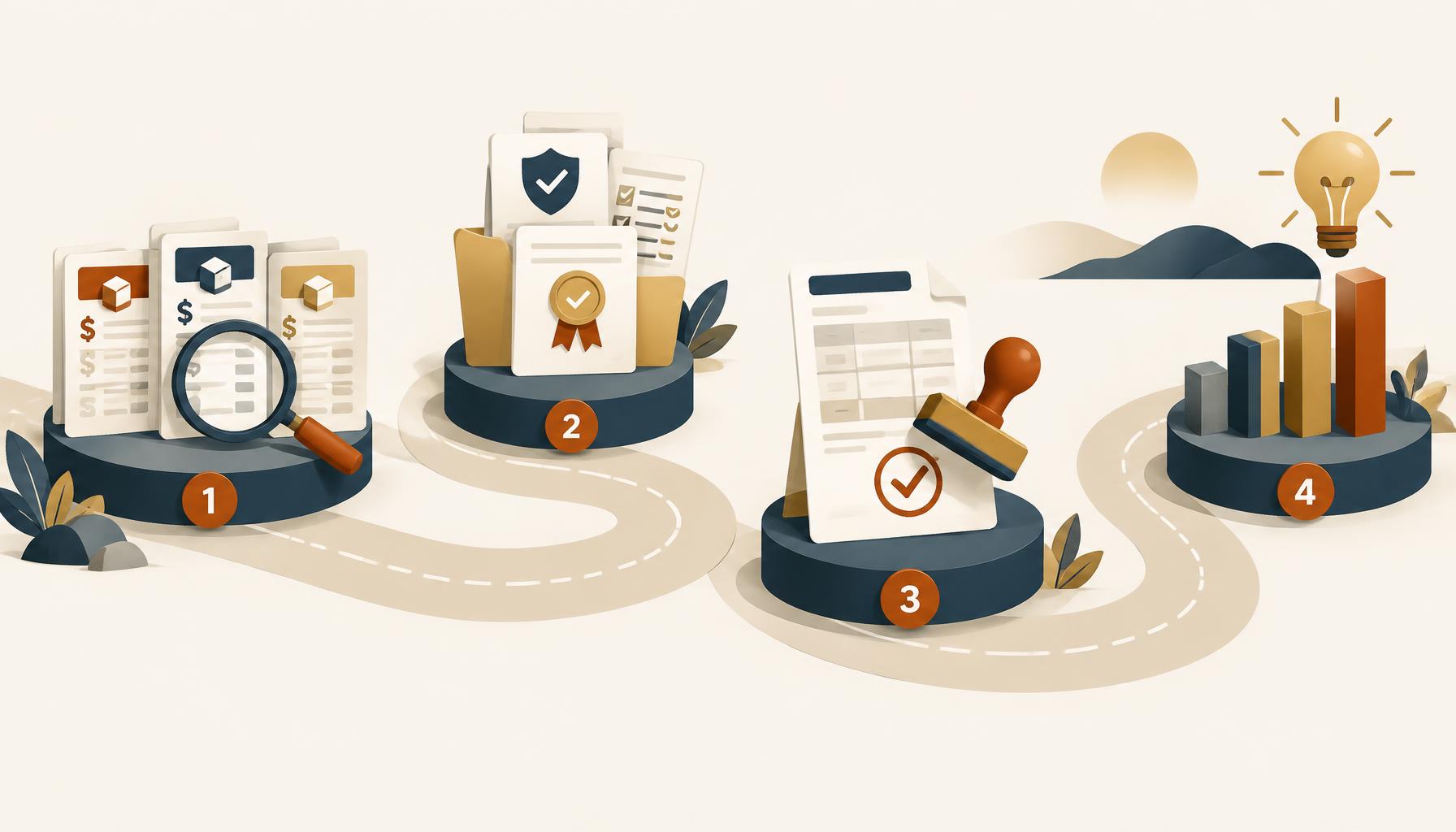
Every procurement team I've worked with says the same thing: "We already automated."
And they have. Requisitions route. POs go out. The ERP hums along.
Yet ask a buyer how they spent Tuesday. The answer is often the same. Chasing a missing certificate. Copying five quotes into one sheet. Rebuilding last year's reasoning for an auditor.
The paperwork got faster. The thinking didn't.
That's the gap modern procurement automation is built to close.
Procurement Automation, Explained In Plain Words
Procurement automation is the use of software to handle the repeatable steps of buying. Think collecting supplier data, checking documents, comparing quotes, routing approvals, raising orders and keeping records.
It comes in two layers. Most teams have the first. Few have the second.
| Layer | What It Does | Typical Tools |
|---|---|---|
| 1. Process automation | Moves work along fixed rules: route a requisition, raise a PO, send a reminder | Procurement ERP software, automated purchasing software, approval workflows |
| 2. Intelligent automation | Reads, checks and reasons over messy inputs, then recommends the next step | AI agents grounded in your own data |
Layer one is classic procurement process automation. It's why your procurement software system can push a PO out in seconds.
But automated procurement systems built on rules hit a wall fast. Rules need clean inputs. Procurement runs on PDFs, scans, emails and "see attached".
Layer two is where AI comes in. It reads the document, understands what it means and tells you what matters. That's the layer most teams are missing, and it's where the time actually goes.
Why AI For Procurement Matters Now
For years, AI in buying sounded like a conference slide. Not any more.
72%
of procurement leaders are prioritising generative AI in their strategies.
Gartner, 2024
<20%
of the data available to procurement teams is used for decisions.
McKinsey, 2026
3.2x
returns on generative AI for top performers, against a little over 1.5x for peers.
Deloitte CPO Survey, 2025
Why the rush? Three reasons stand out.
- 1
Decisions run on a sliver of the data.
Procurement teams use less than 20% of the data available to them for decisions, according to McKinsey's 2026 research. The rest sits in attachments, inboxes and old POs.
- 2
Value leaks quietly.
McKinsey's 2025 work on value leakage points to contract optimisation and compliance as two large areas where value drains away unnoticed.
- 3
The leaders are pulling ahead.
In Deloitte's 2025 CPO Survey of over 250 procurement chiefs, top performers earn 3.2x returns on generative AI. Their peers expect a little over 1.5x.
So what changed? Generative AI in procurement can finally read what rules never could: scanned quotes, contract clauses, loose email replies. Gartner calls this multimodality, and names it with agentic reasoning and AI agents as the three advances reshaping the function.
Is procurement AI ready to trust? With guardrails, yes. In McKinsey's 2024 research, 66% of CPOs felt results were still years away, citing accuracy and security. Those concerns shape everything in the rest of this guide: ground the AI in your data, show its working, and keep people on the decisions.
What To Automate First In Procurement
Here's the mistake I see most: teams try to automate everything at once. Twelve months later, they have a roadmap and no results.
Pick your first process with a simple test. The best starting point ticks all five boxes:
High volume
It happens every week, not every quarter.
Document-heavy
People spend hours reading and retyping.
Money on the line
A wrong call costs real money.
Easy to measure
You can time it before and after.
Safe to try
People still approve the outcome.
Run your processes through that test and one usually wins.
- 1
Start
RFQs And Quotation Comparison
Every quote arrives in a different format. Scope hides in the fine print. The lowest price is often not the lowest cost, a point Gartner's 2024 research on total cost of ownership makes plainly. RFQ automation reads every quote, checks it against your spec and recommends the best fit, with reasons. Most automated RFQ tools stop at sending the request. The value is in reading the replies.
- 2
Next
Vendor Onboarding
Same documents, same checks: certificates, tax registrations, bank details, expiry dates. Generative AI for procurement reads them, flags what's missing and routes exceptions to the right person.
- 3
Then
Purchase Approvals And PO Drafts
Once supplier data is clean, requests can be checked against budget and policy, routed by value, and turned into PO drafts in your ERP.
- 4
Later
Procurement Analytics And Supplier Intelligence
With clean, connected data, you can ask plain-language questions about spend, supplier performance and price trends.
Public tenders follow the same pattern. GeM bid processing automation shows how tender requirements can be read and prepared for human review. Supplier checks map closely to KYC and onboarding automation, and once orders flow, invoice processing automation matches invoices back to the PO.
How To Start: Best Practices For Implementing AI In Procurement
You don't need a transformation programme. You need one process, one month and a clear way to measure.
Here's a procurement automation process that works for teams of any size.
Week 1
Pick and define
Choose one live RFQ. Write down what "best fit" means: spec, scope, certificates, delivery, warranty and terms.
Week 2
Connect
Link the real sources: inbox, shared folders and ERP. No cleaned-up exports.
Week 3
Run side by side
Let the AI read, check and recommend while your team works as usual. Compare the two.
Week 4
Measure and decide
Track time to decision, clarification rounds and flags that changed the outcome. Then decide what's next.
Three rules keep it on track:
Keep people on the big calls.
Supplier choice, spend and contracts stay with your team.
Demand the working.
Every recommendation should link back to its source.
Don't rip and replace.
Your ERP stays the system of record. AI sits on top of it.
Where The AI Agent For Procurement Fits
An AI agent for procurement is software that works toward a goal in several steps. It reads, checks, compares and drafts. Then it hands over to a person.
This is agentic AI in procurement, and it's already in use. McKinsey's 2026 research describes a chemicals company piloting agentic AI procurement, where agents draft tenders, prescreen suppliers and evaluate rival bids. Staff efficiency rose 20 to 30%.
The benefits of autonomous procurement, in plain terms:
Speed
Work that took days is ready in minutes.
Consistency
The same rules on every case, whoever is on leave.
Depth
Every attachment is read, not just the first page.
Memory
Every decision is saved with its reason, ready for the next buyer and the next audit.
But autonomy needs a fence. Here's where Mimasa draws it:
The Agent Handles
- Reading and checking documents
- Building comparisons
- Recommending, with reasons
- Drafting POs and follow-ups
Your People Keep
- Choosing the supplier
- Approving the spend
- Signing the contract
- Changing the policy
No commercial or financial commitment happens without a person's yes. Access is set by role. Sensitive data is masked before any AI model sees it. Every run and decision is recorded.
Choosing Procurement Automation Software Without The Jargon
Shop for procurement automation tools and the labels pile up fast. Here's a quick translation guide.
| What You'll Hear | What It Usually Means |
|---|---|
| Automated procurement software | Rules that route requests and raise orders |
| AI procurement portal | A supplier-facing portal with AI features added |
| Artificial intelligence procurement portal | Often the same thing, with a longer name |
| Machine learning procurement portal | A portal that learns patterns, such as spend categories |
| Autonomous procurement AI software | Systems that complete low-risk buys with little manual work |
| Multi-agent autonomous procurement software | Several AI agents, each with one job, passing work along |
| Agentic AI procurement automation software | Agents that plan and take multi-step actions toward a goal |
| Autonomous procurement agentic AI software | The same idea, stressing how much runs without a person |
The label matters less than one question:
Does it just move documents, or does it understand them?
Before you sign for any AI powered procurement software, check that it:
- 1Reads your messy documents, not a clean demo file
- 2Checks against your rules, not just extracts fields
- 3Links every finding to its source
- 4Recommends a next step, with reasons
- 5Keeps approvals with people
- 6Works with your ERP instead of replacing it
- 7Saves every decision with its reason
- 8Controls who sees what
Mimasa AI was built to clear all eight.