
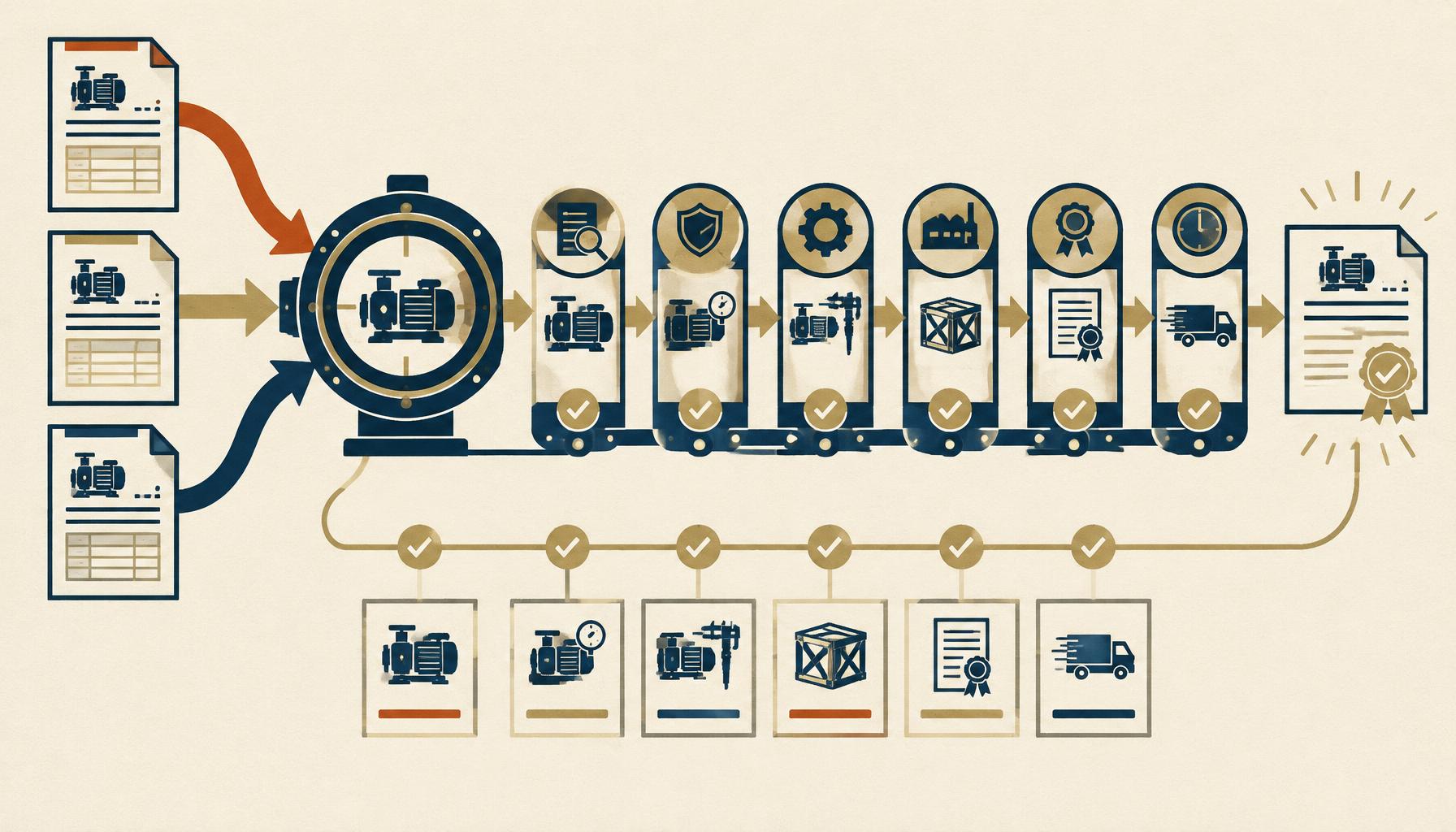
The rest of this guide shows how to do each step in plain terms. It ends with a short example and a checklist you can reuse.
Why Evaluating Supplier Quotations Goes Wrong
Why do supplier quotes so often mislead? Because three quotes rarely describe the same thing.
Picture it. Three quotes land in your inbox. One is a PDF. One is a spreadsheet. One is a long email. The lowest number looks good, so it wins. A few months later, someone asks why freight was billed on top.
Nobody was careless. The quotes were simply not comparable. So is the lowest quote always the best choice? No. Four traps sit behind it:
- Different scope. One supplier includes installation. Another does not.
- Different terms. Payment days, warranty, delivery dates and taxes all shift the real price.
- Missing proof. A certificate has expired, or was never attached.
- Hidden later costs. Service, spares and downtime show up after you sign.
How much can the price alone tell you? Less than people think. Gartner's research on total cost of ownership (June 2024) warns that a narrow focus on unit price alone can lead to higher supply chain costs.
And what does L1 mean? In public buying, price ranking follows the eligibility and responsiveness checks in the applicable tender. Refer to India’s Manual for Procurement of Goods and your stated evaluation rules. A low price does not excuse a failed requirement.
That is why the six steps below put the price in fourth place.
Step 1: Set The Yardstick Before The Quotes Arrive
Decide how you will judge before you see a single price. Once the numbers are in front of you, it is hard to stay fair.
What is a request for quotation, and why does it matter here? An RFQ is how you ask suppliers to price the same need. So it must be clear. Include quantity, specification, delivery place and date, and any standards. A vague request gets vague quotes.
Which criteria should you use to evaluate suppliers? Keep the list short. Five or six is plenty. Most buyers start with these:
- Total cost, not just price
- Quality and fit with the specification
- Delivery and lead time
- Supplier record
- Support after the sale
Put them in order of importance. Agree the order with your team before the quotes arrive.
Then split your needs into two lists:
- Must-haves. A quote that fails any one of these is out. Examples: a valid licence, a required safety standard, a hard delivery date.
- Nice-to-haves. These earn credit but do not disqualify. Examples: a longer warranty, free training, local service.
Write this down and share it. A clear yardstick also protects you later. If a supplier asks why they lost, you can point to the rules you set on day one.
Step 2: Make Your Quotation Comparison Fair
How do you compare supplier quotes fairly? Rebuild every quote on one common sheet. A real quotation comparison only works when each quote is measured the same way.
What should a good supplier quotation include? Use this list as your check:
| Check | What to look for |
|---|---|
| Scope | Does each quote cover the same items, quantities and services? |
| Units | Per piece, per kg, per set? Convert to one unit. |
| Taxes and duties | Included or extra? |
| Freight and installation | Included, extra or missing? |
| Payment terms | Advance, 30 days, 60 days? Time has a cost. |
| Delivery | Date, place and who carries the risk in transit. |
| Validity | How long is the price held? |
| Warranty | How long, and what it covers. |
- Check
- Scope
- What to look for
- Does each quote cover the same items, quantities and services?
- Check
- Units
- What to look for
- Per piece, per kg, per set? Convert to one unit.
- Check
- Taxes and duties
- What to look for
- Included or extra?
- Check
- Freight and installation
- What to look for
- Included, extra or missing?
- Check
- Payment terms
- What to look for
- Advance, 30 days, 60 days? Time has a cost.
- Check
- Delivery
- What to look for
- Date, place and who carries the risk in transit.
- Check
- Validity
- What to look for
- How long is the price held?
- Check
- Warranty
- What to look for
- How long, and what it covers.
What if something is missing? Do not guess. Ask the supplier in writing. Give every bidder the same chance to clarify. Then add the gap back in. If one quote leaves out freight, add an honest estimate. Now the quotes stand on level ground.
This is the most repetitive part of the job. It is also where copy-paste errors creep in. The more formats your quotes arrive in, the more time it takes.
Explore RFQ and quotation comparison within procurement automation. For government bid documents, see GeM bid processing automation.
Step 3: Check Compliance And Credentials
Now apply your must-haves. This step is pass or fail. A quote that fails here does not move on, however low its price.
What do you actually check? Four things:
- Specification match. Does the offer meet the need, or is it "equivalent" in name only? Look at ratings, materials and tolerances.
- Certificates and licences. Are they attached, valid and in the right name? Check the expiry dates. An expired certificate is a common and easy-to-miss gap.
- Commercial terms. Does the supplier accept your payment, liability and delivery terms, or did the wording change?
- Completeness. Is every requested document and form there?
What if a quote is almost right? Write down the deviation. For example: "Motor rating is one step below the specification." Then let a named person decide whether to accept it. A small deviation passed without a note will matter later, when someone asks why.
Public procurement follows the stated eligibility and bid-evaluation rules. Private buyers may need less paperwork, but the logic holds: fit first, price second.
Step 4: Test The Price And See The Total Cost
Only now do you look hard at money. Do it in two passes.
Pass 1: Is The Price Fair?
Is the cheapest quote the cheapest deal? Often not. A fair price is not always the lowest one. These standard price checks help:
- Compare the bids. Prices close to each other are usually competitive.
- Check past prices. Adjust what you paid last time for inflation and volume.
- Check the market. For commodity-driven goods, compare against a price index.
- Look at the outliers. Check an unusually low bid for completeness and past performance before you accept it.
Should you worry about a quote far below the rest? Ask a calm question first. It may be an error. It may leave out scope. Or the supplier may plan to recover the money later.
Pass 2: What Will It Really Cost?
What is total cost of ownership? It is the full cost of getting and using something over its life, often shortened to TCO. Gartner's principles of total cost of ownership (June 2024) covers life-cycle costs beyond the purchase price.
For most goods, add:
- Freight, duties and insurance
- Installation and training
- Service, spares and consumables
- Downtime and failure cost
- Disposal or end-of-life cost
Picture an iceberg. The price is the tip. Most of the mass sits below the water.
You will not always have perfect numbers. That is fine. Use honest estimates and note your assumptions. Apply them to every supplier in the same way.
Purchase Price Is Only One Layer
- Purchase: quoted items and quantities
- Arrival: freight, duties, insurance and installation
- Use: training, service, spares and consumables
- Risk: failure, downtime and end-of-life cost
Step 5: Judge Supplier Risk And Delivery
A good quote from a weak supplier is still a bad deal. This step asks one question. Can this supplier deliver, on time, at this quality?
Look at five areas:
- Track record. Ask for references. Check how they performed on similar orders, ideally with your own past data too.
- Capacity. Can they handle your volume and deadline alongside their other work?
- Financial health. Can they survive a bad quarter? A supplier that fails mid-order costs far more than a few points of price.
- Dependence risk. Do they rely on one factory, one raw material or one port?
- Support after the sale. Who answers when something breaks? How fast, and where?
Why does this matter now? Gartner’s June–July 2024 survey of 258 sourcing and procurement leaders found that 42 per cent named supply disruption as the foremost risk to procurement success. Gartner advises segmenting suppliers of critical goods and services.
Not every purchase needs a deep review. Match the effort to the stakes. Office supplies need a glance. A critical machine needs a proper look.
Also think about spreading. If one supplier already provides most of what you buy, a second source may be worth a small premium.
Write a short risk note for each shortlisted supplier. Two or three lines are enough. Rate it low, medium or high, and say why.
Supply chain analytics connects the supplier review with wider supply and delivery context.
Step 6: Decide, Document And Close The Loop
Now bring it together. Set each compliant quote against the criteria from Step 1. Put the total cost and the risk note beside it.
If one supplier leads on every measure, the choice is easy. If not, talk it through. Ask:
- Which supplier gives the best value, not just the best price?
- Is the leader's edge big enough to justify any added risk?
- Is there room to negotiate? Price, payment terms and warranty are the usual levers.
Then write down the decision. A good record is short. It covers:
- The quotes received and the date.
- Any gaps found, and how they were handled.
- The comparison and the total-cost view.
- Who approved the choice, and why.
This record is your safety net. It answers an audit, a finance query or a supplier challenge in minutes, not days.
Finally, close the loop:
- Tell the winning supplier clearly. Confirm the terms in writing.
- Tell the others politely. Give a short, honest reason. They will bid better next time.
- After delivery, compare what you were promised with what you got. Feed that back into your supplier record.
That last step turns a one-off checklist into a habit that improves every round.
A Quick Example: Three Quotes For Two Industrial Pumps
What does this look like in practice? Say three suppliers quote for two pumps. The figures are made up to show the method.
| Supplier | Quoted price | What the evaluation finds | Result |
|---|---|---|---|
| A | ₹9.60 lakh | Leaves out freight and installation. ISO certificate has expired. Short warranty. | Looks cheapest, but is not |
| B | ₹10.40 lakh | Everything included. Certificates valid. Longer warranty. | Best overall value |
| C | ₹10.10 lakh | Complete, but the motor rating is below spec. | Needs a decision. Rejected here. |
- Supplier
- A
- Quoted price
- ₹9.60 lakh
- What the evaluation finds
- Leaves out freight and installation. ISO certificate has expired. Short warranty.
- Result
- Looks cheapest, but is not
- Supplier
- B
- Quoted price
- ₹10.40 lakh
- What the evaluation finds
- Everything included. Certificates valid. Longer warranty.
- Result
- Best overall value
- Supplier
- C
- Quoted price
- ₹10.10 lakh
- What the evaluation finds
- Complete, but the motor rating is below spec.
- Result
- Needs a decision. Rejected here.
Supplier A was the lowest quote on day one. Add the missing items and check the paperwork, and it is no longer the best choice. Supplier B costs the most upfront and gives the best result overall.
That is the point of evaluating a quote, not just comparing it.
Illustrative Scenario: These Pump Quotes Are Fictional, Not Customer Results.
Seven Common Mistakes, And A Checklist You Can Reuse
These slips turn up again and again:
- Choosing on price alone. The lowest number is a starting point.
- Changing the rules midway. A new criterion added after you see the quotes looks unfair, and often is.
- Letting scope drift. Different quotes mean different jobs.
- Skipping expiry dates. Certificates and price validity both lapse.
- Ignoring the outlier. A very low quote needs a question, not a cheer.
- Keeping no record. If it is not written down, it did not happen.
- Never reviewing after delivery. Without feedback, the same mistakes repeat.
Your 6-Step Supplier Quotation Checklist
- Needs, must-haves and criteria written down before quotes arrive
- Every quote rebuilt on one common sheet
- Gaps raised with suppliers in writing
- Specifications, certificates and expiry dates checked
- Deviations noted, with a named approver
- Price tested against other quotes, past prices or the market
- Outlier prices questioned
- Total cost of ownership estimated for each supplier
- Supplier risk noted: record, capacity, finances, support
- Decision, reasons and approver recorded
- Winner and other bidders informed
- Delivery reviewed against the promise
RFQ Automation And AI For Procurement: How Mimasa AI Approaches Quote Evaluation
Read the six steps again. The thinking sits in steps 1, 5 and 6. Steps 2, 3 and 4 are mostly reading, matching and checking. That is the work software does well, and it is where we started.
What is RFQ automation? It means software handles the repetitive parts of the quote process, so people keep the judgement. An automated RFQ flow collects responses, extracts comparable fields, flags gaps and prepares the comparison.
Mimasa AI follows one simple chain:
- 01
Connect
- 02
Extract
- 03
Check
- 04
Compare
- 05
Approve
- 06
Act
- Connect. Bring in approved ERP data, files, forms, email and documents.
- Extract. Read prices, dates, terms and other configured fields.
- Check. Flag missing or unclear information against your rules.
- Compare. Prepare an evidence-backed comparison using your criteria.
- Approve. An authorised person reviews suppliers, exceptions and commitments.
- Act. Create a task, prepare a document or update a permitted system.
Can an AI agent for procurement choose the supplier for you? It can prepare the comparison and recommend the next step. It should not decide alone. Suppliers, spend and commercial terms stay with authorised people.
That is how we see agentic AI in procurement: controlled, multi-step work inside a governed process. It is not unrestricted purchasing autonomy. Each agent uses only the data and tools it is given. Every action leaves a record.
Why the caution? McKinsey’s 2024 look at generative AI in procurement notes that leaders worry about accuracy and security. Review steps are built for exactly that. People retain supplier relationships, commercial judgement and approval authority.
Is this the same as procurement automation? It is one part of it. Wider procurement process automation also covers requests, approvals, purchase orders and supplier onboarding. Quote evaluation is a practical place to begin, because the work repeats and the result is easy to review.
Mimasa AI works around the systems you already use. It is not an ERP, a supplier marketplace or a system of record. Your ERP or procurement system keeps that role.
If you are comparing procurement automation tools, ask any vendor, including us, to run a real set of your own quotes. Check three things. Does it show its working? Can you override it? Does it respect your approval rules?
Want to see it on one live RFQ? Request a procurement automation demo. Or read how the pieces fit on our procurement automation page.
See the broader procurement automation approach, including RFQs, approval workflows and supplier records.