
AI Agents vs. RPA: What's Actually Different (And Why It Matters)
AI agents and RPA both promise automation but they're not the same thing. Here's the real difference, explained simply, with the data behind the hype.
By Team Mimasa AI · September 1, 2026 · 7 min read
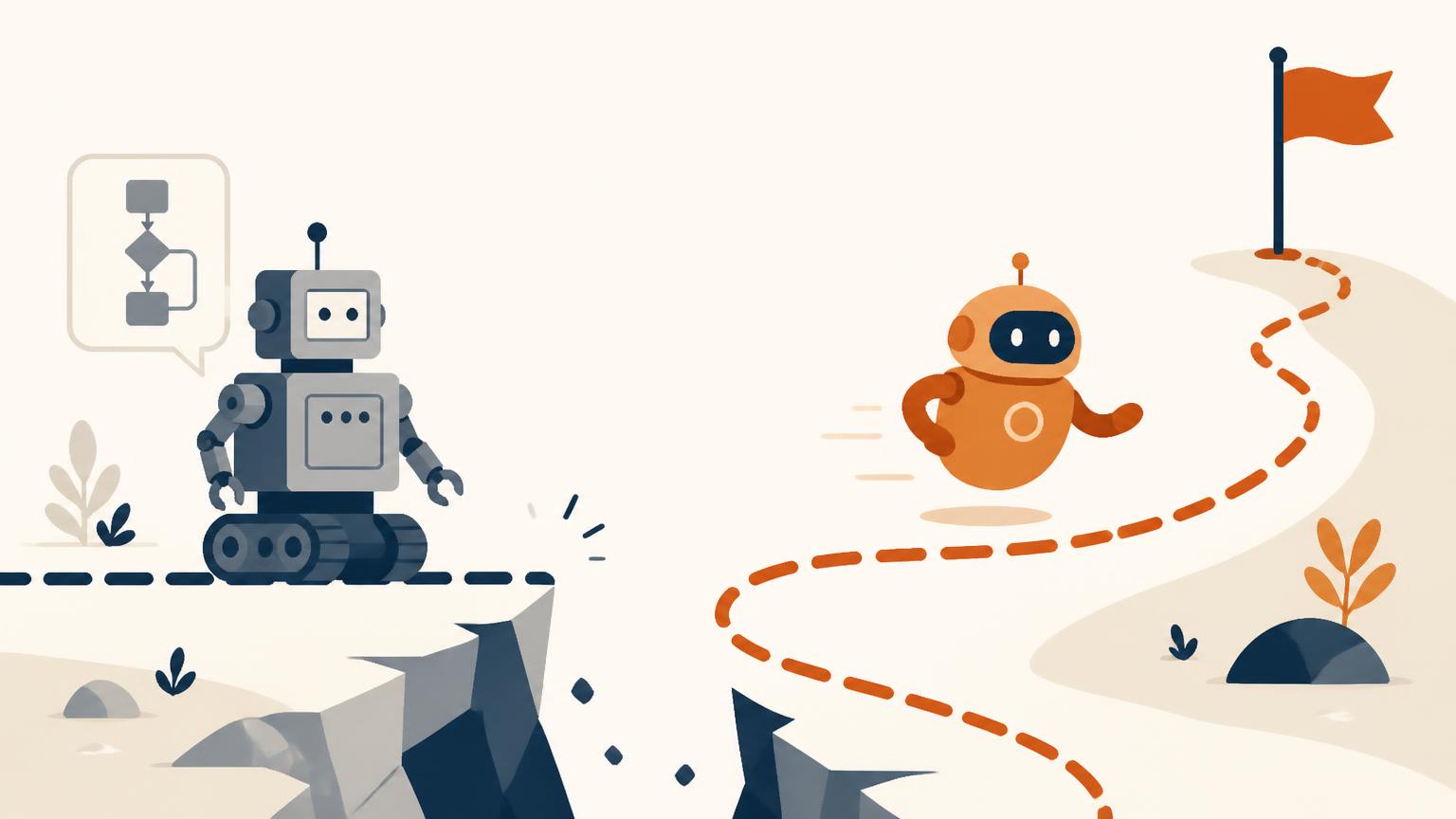
Somewhere in your company, there's an automation that breaks the moment someone renames a column.
Maybe it's a bot that logs into a portal every morning, downloads a report, and pastes it into a spreadsheet. It works great until the portal's login page changes, or the file gets saved with a slightly different name. Then it just stops. Quietly. Nobody notices until the numbers look wrong two weeks later.
That's RPA (Robotic Process Automation). Lately, vendors have started using "AI agents" almost interchangeably with it, like it's the same thing with a newer name. It isn't. And the difference isn't a technicality — it's the difference between automating a task and automating a decision.
RPA: Great At Following Instructions, Bad At Surprises
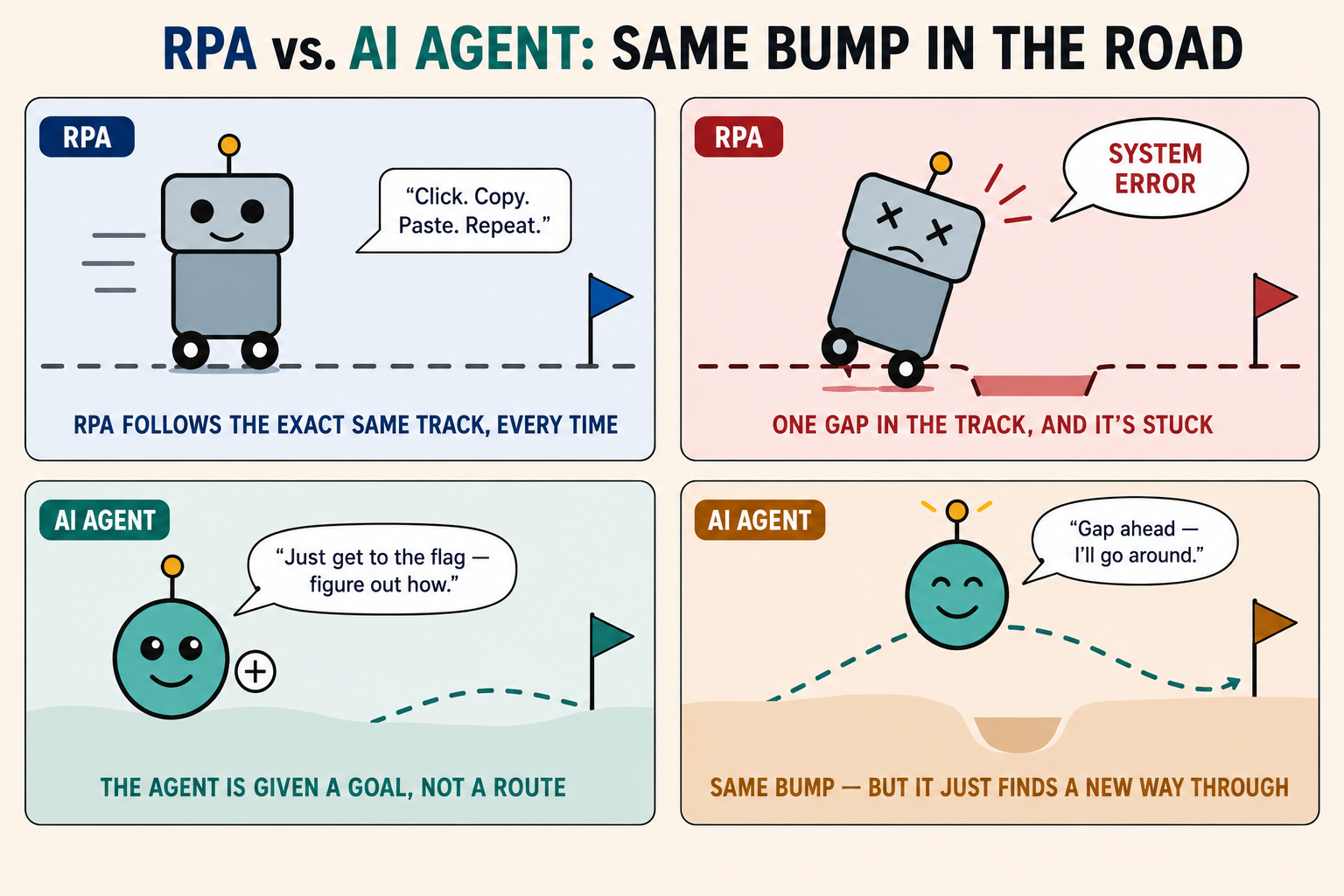
RPA does exactly what it's told, exactly the same way, every time: click here, copy this, paste it there, if X then Y.
It doesn't understand why it's doing any of it; it's just executing steps. That makes it fast, cheap, and reliable for stable, repetitive work. It also means the moment reality shifts even slightly from the script, it doesn't adapt. It just fails. That's part of why Gartner has flagged so much "agent-washing" in the market lately; plenty of vendors are just relabeling old RPA bots as "AI agents" without changing what's under the hood.
AI Agents: Given A Goal, Not A Script
An AI agent isn't handed a fixed sequence of clicks — it's given an objective, like "reconcile this month's vendor invoices," and it works out how to get there.
It figures out what data it needs, pulls it from wherever it lives (even across several systems), notices when something looks off, and decides what to do next, sometimes acting on its own, sometimes flagging a person. RPA needs the whole path mapped out in advance. An agent can find the path itself, and adjust when the path changes. It's a big enough shift that Gartner expects roughly 4 in 10 enterprise applications to include agents like this by the end of 2026.
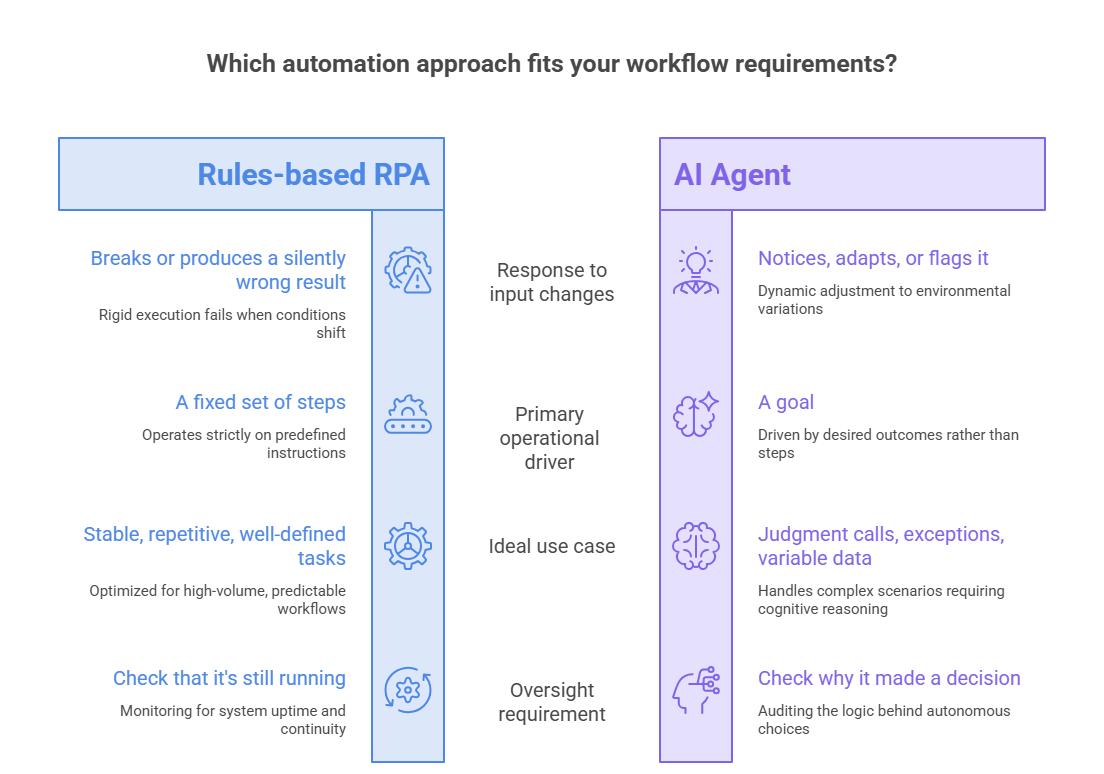
That one behavior — what happens when things don't go as planned — tells you more than any vendor's pitch deck will. It also explains why, even with adoption accelerating fast, Gartner's own CIO survey found only about 17% of organizations have actually deployed a real agent so far. Most are still figuring out where the line between "true agent" and "rebranded bot" actually sits.
RPA Or Agent? Here's The Real Test
Ask this for each process on your list: does doing it well require judgment, or just repetition?
Stick With RPA
Mostly repetition, stable rules, low ambiguity. RPA is still the cheaper, more predictable choice. Don't drop it just because "agentic" sounds newer.
Bring In An Agent
Judgment calls, variable data, decisions that depend on context. That's where an agent earns its cost, and where RPA was never built to succeed.
Worth going in with eyes open, too: Gartner expects over 40% of agentic AI projects to be scrapped by 2027, and it's rarely because the technology failed — it's usually because it was pointed at the wrong problem or rolled out without proper governance. So most companies doing this well aren't ripping out their RPA bots. They're keeping RPA for the truly fixed, repetitive work, and bringing in agents for the messy stuff: invoice exceptions, cross-system reconciliations, and the "why did this number move?" questions that used to land on an analyst's desk every week.
That's the layer Mimasa AI is built for. It unifies data scattered across your systems, uses AI agents to actually decide what that data means and what should happen next, and then carries out the resulting work across connected enterprise systems without needing every scenario mapped out in advance the way RPA does. It's not a rebranded bot with a new coat of paint; it's built specifically for the judgment calls that traditional automation was never designed to handle.
So if there's a process on your list that keeps breaking every time reality shifts even slightly, that's rarely an RPA problem waiting for a patch. It's usually a sign the process needed an agent all along.
See What An Agent Would Do With Your Process
Bring one process that keeps breaking. We'll walk through where RPA still fits and where an agent genuinely changes the outcome.