
Agentic AI Is Moving To The Factory Floor
The next evolution of manufacturing inspection is not another dashboard. It is AI that participates in the process.
By Team Mimasa AI · August 19, 2026 · 8 min read
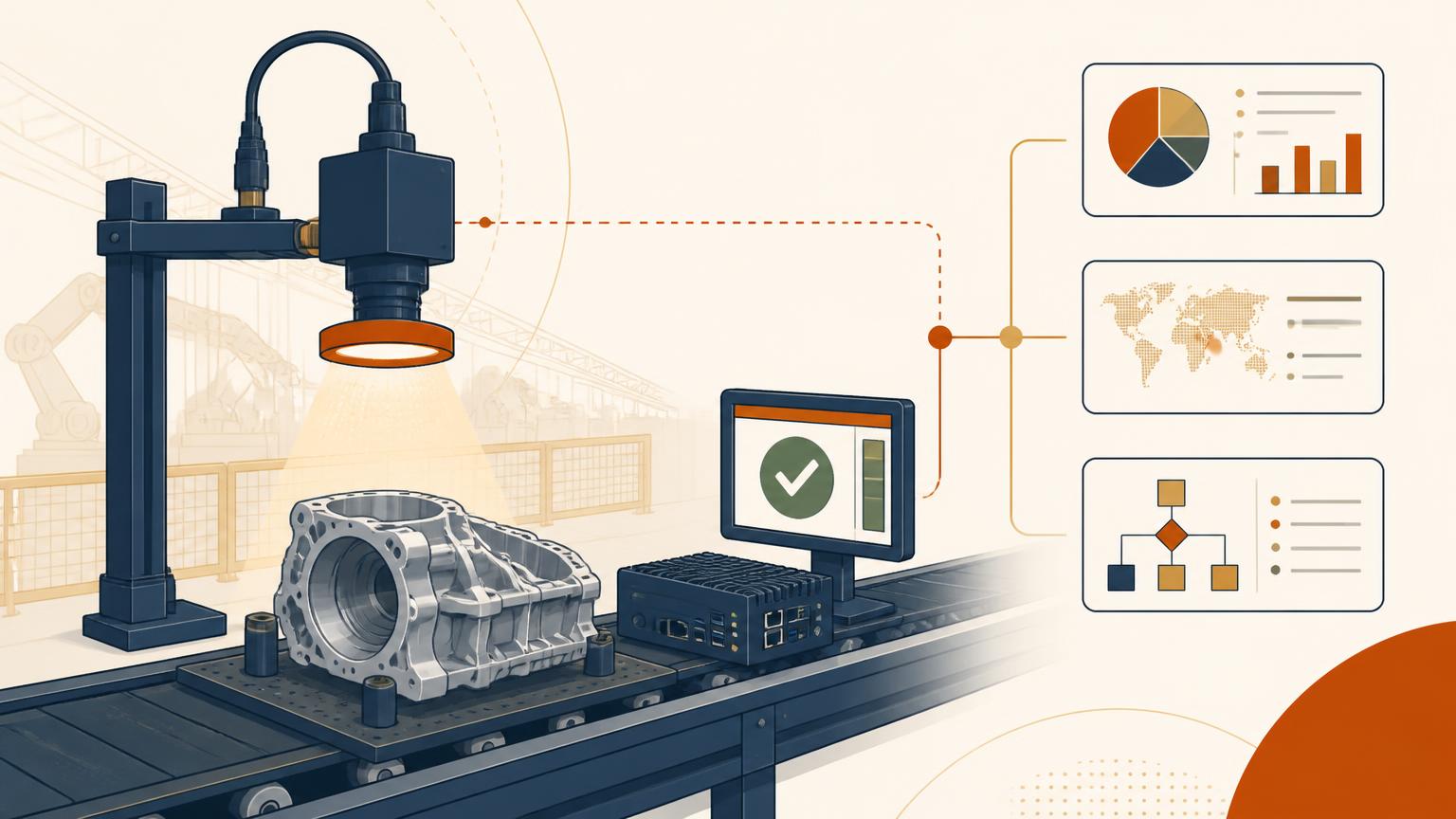
Walk into a modern plant and you will find ERP, MES, PLM, QMS, PLCs and sensors, all running well. Then you will find an operator holding a component under a light, checking whether a batch code is correct.
None of these checks are individually hard. The problem is that they happen thousands or millions of times. Every repetition is another chance for fatigue, misreading or a missing traceability record.
The next wave of manufacturing AI is not better analytics for managers. It is intelligence inside the operational workflow itself.
Manufacturing Does Not Need Another AI Dashboard
First-generation enterprise AI helped people consume information: ask a question, summarise data, generate a report. Useful, but a factory needs more than a description of what happened.
Observe → understand → validate → decide → act → record → escalate.
At a quality station, the component must be identified, imaged, interpreted, compared against the expected production condition, decided on, fed back to the operator, recorded, and sometimes blocked from moving forward. That is not a chatbot. That is an agent participating in an operational process.
What An Agentic Inspection System Looks Like
Three connected layers, none of which require replacing existing plant systems.
1. The Physical Inspection Layer
Industrial cameras, controlled lighting, sensors, NFC and barcode readers, PLCs, stack lights and existing test machines. The aim is not to replace this hardware. It is to connect it to the wider manufacturing process.
2. The Edge Intelligence Layer
Some decisions cannot wait for a cloud round trip. The edge system processes the image locally, applies inspection rules and returns one simple outcome: PASS, FAIL or NOT READABLE. It keeps working when connectivity drops.
3. The Enterprise Intelligence Layer
Component identity, result, image, timestamp, machine, station, shift, operator, batch and attempts become a permanent record — feeding dashboards, reports, notifications and downstream workflows.
Identity Matters More Than PASS Or FAIL
A plant makes 500 components in a shift. 450 pass, 50 fail, and each failure is retried three times. A camera-triggered system logs 600 inspection events — but the plant did not make 600 parts. Naive AI can make the data worse.
The fix is to give each component a digital identity before inspection, for example through an NFC tag or barcode applied ahead of the marking operation. The record then reads honestly:
- Tank ID 005128 — Attempt 1 FAIL, Attempt 2 FAIL, Attempt 3 PASS
- Unique tanks inspected: 1
The manufacturer sees not only that a part eventually passed, but what happened before it passed. In quality assurance, that history is often the more valuable half.
Inspection Should Create Evidence, Not Just Decisions
Traditional systems reduce quality to a status. Agentic inspection produces a digital evidence trail: what was inspected, what the camera saw, what the AI interpreted, what was expected, what was decided, when, where, how many attempts, and the final disposition.
When an OEM raises a complaint months later, the supplier retrieves the original record for that specific component instead of searching paper files. Inspection stops being a moment on the shop floor and becomes a persistent quality record.
Where Agentic AI Fits In Inspection
Once cameras, edge intelligence, identity and workflows exist, the same foundation supports many checks.
Batch Code & Character Verification
Read punched, engraved, printed or laser-marked codes and compare them with production requirements.
Barcode, QR & Data Matrix
Validate component identity and tie the physical part to its digital manufacturing record.
Label Inspection
Confirm the correct label is present, readable and matched to the right component.
Presence & Absence Checks
Detect missing bolts, clips, caps, connectors and other required parts.
Assembly Verification
Check that a product matches the expected visual assembly condition.
Machine Result Assurance
Capture results already produced by test machines so a failed test never quietly becomes an accepted part.
Not every inspection problem belongs to AI. Micron-level metrology and safety-critical measurement still need purpose-built systems. Apply AI where it improves quality, traceability or economics.
The Agent Does Not Stop At Detection
A conventional application displays FAIL. An agentic workflow keeps going:
- 1Detect the failure
- 2Restrict the next configured operation
- 3Create the inspection record
- 4Preserve image evidence
- 5Link the failure to the component identity
- 6Notify the responsible quality personnel
- 7Update the dashboard and shift report
- 8Trigger escalation on repeat failures
That is where the word agentic earns its place. The system is not generating information. It is participating in the process.
The Economics Need To Change Too
Industrial technology is usually sold as specialised hardware, proprietary controllers, licences, integration, engineering and annual maintenance — a capital commitment before a single component has been inspected.
If the outcome is inspect this component and keep its digital record, the commercial unit can match it. Hardware stays a transparent purchase the manufacturer owns. The intelligence layer runs on consumption: pay per component inspected.
That changes the question from "how much does the AI software cost?" to "what does it cost us to inspect one component?" — a far more natural manufacturing metric, and one that scales for a plant making 10,000 parts a month as easily as one making 100,000.
Start With One Problem, Then Reuse The Foundation
Nobody needs to begin by transforming an entire factory. Begin with one measurable problem — batch-code verification is a good candidate. Measure accuracy, response time, quality improvement and cost per part.
Building it establishes the edge infrastructure, the machine connection, component identity, the inspection record and the workflow. The next use case — leak-test assurance, surface inspection, assembly verification, operator adherence — no longer starts from zero.
Humans stay responsible for engineering judgment, safety decisions, root-cause validation, process changes and quality approvals. What goes away is repetitive observation and coordination work, replaced by better evidence when judgment is actually needed.
Questions Manufacturers Ask Us
Practical answers on architecture, traceability and commercial models.
See It As A Production Use Case
The ideas in this article are already implemented as a component inspection and digital traceability use case for manufacturing teams.
Explore The Use Case